|
S |
M |
T |
W |
T |
F |
S |
|
|
1
|
2
|
3
|
4
|
5
|
6
|
|
7
|
8
|
9
|
10
|
11
|
12
|
13
|
|
14
|
15
|
16
|
17
|
18
|
19
|
20
|
|
21
|
22
|
23
|
24
|
25
|
26
|
27
|
|
28
|
29
|
30
|
31
|
|
|
|
|
|
Forums10
Topics39,709
Posts564,481
Members14,611
| |
Most Online9,918
Jul 28th, 2025
|
|
|
|
Joined: Dec 2012
Posts: 3,667 Likes: 1103
Sidelock
|
OP

Sidelock
Joined: Dec 2012
Posts: 3,667 Likes: 1103 |
A few years ago, the topic of declining grouse populations was bandied about here. I know a study by Pennsylvania's DNR was cited as ongoing, as was perhaps another funded by the Ruffed Grouse Society(?). Were there any conclusions from those studies? Anything published?
If I remember correctly, corvis species (specifically crows) had been found to be highly susceptible to bird flu and, accordingly, that connection to grouse was being studied in-depth. Lots of ideas were mentioned at that time, including the predation by wild turkeys and skunks of the chicks, and even increasing coyote populations (when I was much younger, feral cats would often get blamed). I have also heard (more-recently) discussions about certain types of pesticides being suspected in declining bird populations world-wide, specifically nicotine-base pesticides.
Considering the technical depth and breadth of the readership here, can anyone speak to this?
Last edited by Lloyd3; 02/22/20 09:48 PM.
|
|
|
|
|
Joined: Apr 2010
Posts: 495 Likes: 71
Sidelock
|
|
Sidelock
Joined: Apr 2010
Posts: 495 Likes: 71 |
Hi Lloyd,
Most game departments agree on the one thing that has the most effect on grouse, cover aging out. A reduction in the use of paper causing less cutting for pulp, soft lumber markets, a population that adores mature forests to the point of lawsuits. Jury is out on west Nile, turkeys and vermin being smaller contributors.
Chief
|
|
|
|
|
Joined: Nov 2015
Posts: 671 Likes: 57
Sidelock
|
|
Sidelock
Joined: Nov 2015
Posts: 671 Likes: 57 |
The cause of the 11-yr cycle in Ruffed Grouse populations remains unanswered. Last research report I read showed weaknesses in Gordy Gullion's "male aspen bud theory" from the 1950's and tended toward the existence of a complex predation cycle. Maybe another hundred years of data gathering will provide the answer. While all this was happening, the RGS and state agencies have learned a lot about how to create good breeding habitat for the species. I suggest all Ruffed Grouse and Woodcock hunters join the combined RGS-American Woodcock Society now called the RGS-AWS.
|
|
|
|
|
Joined: Feb 2008
Posts: 11,837 Likes: 698
Sidelock
|
|
Sidelock
Joined: Feb 2008
Posts: 11,837 Likes: 698 |
Lloyd could tell you that logging and timber harvesting is alive and well in his native state of Pennsylvania. There is no shortage of large tracts of mature forest that gets selective cutting or clear cutting. Yet ruffed grouse numbers have declined significantly over the last 20 -30 years.
It has gotten bad enough that the late grouse season was cancelled a couple years ago. I personally think that the introduction of the Eastern Coyote into Pennsylvania has had the greatest effect on reducing the population of grouse and other small game species. It would be hard to blame herbicides for lower grouse numbers since grouse do not live in areas that are sprayed. Our Game Commission has done a good job of implementing things that have contributed to reducing the overall number of active hunters, so we sure can't blame the decline on over-harvesting. But our illustrious Game Commission also is flush with cash from timbering, gas, and oil drilling, etc., on State Game Lands. So they don't seem to be at all responsive to the hunters who still purchase licenses.
Voting for anti-gun Democrats is dumber than giving treats to a dog that shits on a Persian Rug
|
|
|
|
|
Joined: Jan 2002
Posts: 11,574 Likes: 167
Sidelock
|
|
Sidelock
Joined: Jan 2002
Posts: 11,574 Likes: 167 |
Usually, the predators that have the greatest impact on ground-nesting birds (like all of our upland species) are nest predators. Raccoons often top the list. One reason is that as fur prices have dropped and trapping pressure has declined (and the animal rights crowd has done their best to make it politically incorrect to wear fur), numbers of furbearers have increased. Another negative impact on trapping has resulted from the decreasing number of farmers. A lot of farm kids used to make their spending money by running a trap line. Not nearly as many farm kids these days, not as popular to run a trap line, and easier money to go into town and work in a fast food restaurant. The Iowa DNR used to sell something over 5,000 youth trapping licenses annually. These days it's more like 500.
Definitely more concern about West Nile Virus these days. Even in years with good drumming counts when improved grouse numbers are anticipated, the expected population bump doesn't seem to happen. Although studies have shown that quite a few adult grouse shot by hunters have been exposed to WNV (contain antibodies) but have survived, science seems to indicate that it's more lethal on chicks. If that's accurate, that would explain why--even when drumming counts are high and nesting conditions are good--grouse numbers don't show much of an increase, if any.
Last edited by L. Brown; 02/23/20 07:25 AM.
|
|
|
|
|
Joined: Feb 2008
Posts: 11,837 Likes: 698
Sidelock
|
|
Sidelock
Joined: Feb 2008
Posts: 11,837 Likes: 698 |
In studies of dead birds that died from West Nile Virus, about 80% of the dead birds were corvids, i.e., crows, ravens, rooks, jackdaws, jays, magpies, treepies, choughs, and nutcrackers. Yet these avian species do not seem to be in the same steep decline as ruffed grouse.
Nest predation has always been a factor in the survival of ground nesting birds, and trapping may have helped to limit the numbers of nest predators. But it is almost a certainty that the reduced numbers of young kids running traplines has been more than offset by a vastly increased number of Eastern Coyotes that also eat young racoons, feral cats, foxes, etc. Trappers run their traplines for a limited number of weeks each winter. But coyotes hunt and kill every day of the year.
Voting for anti-gun Democrats is dumber than giving treats to a dog that shits on a Persian Rug
|
|
|
|
|
Joined: Jan 2004
Posts: 7,597 Likes: 657
Sidelock
|
|
Sidelock
Joined: Jan 2004
Posts: 7,597 Likes: 657 |
Larry, we had a lot of pheasants in the 90s and we had about the same amount of trapping (close to nothing) and probably even more predators, especially foxes. The loss of farmsteads and old barns and other outbuildings has dramatically reduced some predators like raccoons, skunks, and opossums. I don't know what the status of foxes are statewide, but around here they seem to be just coming back however slightly from a long hiatus.
Most people that study these things put a lot more emphasis on winter kill hens and especially spring nesting conditions.
_________ BrentD, (Professor - just for Stan) =>/ ![[Linked Image from i.imgur.com]](https://i.imgur.com/qclHjMQ.jpg)
|
|
|
|
|
Joined: Mar 2011
Posts: 4,214 Likes: 661
Sidelock
|
|
Sidelock
Joined: Mar 2011
Posts: 4,214 Likes: 661 |
Coyotes have a unique ability to control litter size based on population levels. When they sing at night females sense population numbers by responses to the singing. When low, their litters can have 20 pups. When high, as few as 4. A federal study at the Savannah River Plant, aka "Bomb Plant" inserted vaginal transmitters into pregnant does. When the fawn dropped, the transmitters activated which allowed the biologists to quickly go to the drop site. More often than not the remains of the fawns were found and DNA testing confirmed coyote presence. 500 coyotes were exterminated in the study site over the course of a year. The following year there was no significant reduction in fawn kills by coyotes. Coyotes survive regardless of efforts to control their population.
|
|
|
|
|
Joined: Jan 2002
Posts: 10,238 Likes: 142
Sidelock
|
|
Sidelock
Joined: Jan 2002
Posts: 10,238 Likes: 142 |
here is a typical study report... https://www.kinseysoutdoors.com/ruffed-grouse-decline-and-their-future-in-the-keystone-state/problem is blamed on the usual: -weather -habitat -disease all factors which have no practical solution...how convenient for the self serving taxpayer funded state game managers... have read a lot of these taxpayer funded studies...none of them address the real problem, which is predation... put bounties on coyotes, turkeys and owls...then observe an increase in grouse numbers...and bunny rabbits...
Last edited by ed good; 02/23/20 10:27 AM.
keep it simple and keep it safe...
|
|
|
|
|
Joined: Nov 2015
Posts: 671 Likes: 57
Sidelock
|
|
Sidelock
Joined: Nov 2015
Posts: 671 Likes: 57 |
When coyotes returned to eastern North Dakota, we had a big reduction in numbers of the three worst predators of ground nesting birds, striped skunks, raccoons, and red fox. Don't know about pheasants, but nest success of ducks seems to have improved even with the big decrease in traditional nesting cover. My friend who runs a Rogator sees good numbers of duck broods in ponds totally surrounded by soybeans. I think no-till and minimum-till have helped in this regard.
Bounties were a real waste of taxpayer dollars in the past and would be even worse today with so few bounty hunters.
|
|
|
|
|
Joined: Feb 2008
Posts: 11,837 Likes: 698
Sidelock
|
|
Sidelock
Joined: Feb 2008
Posts: 11,837 Likes: 698 |
Bounties were a real waste of taxpayer dollars in the past and would be even worse today with so few bounty hunters.
I'm not sure how you could say this when the real reason we have so few bounty hunters is the simple fact that there are no longer bounty payments for killing predators. And everyone knows that coyotes don't kill and eat ducks. Here's some nice photos of coyotes saving ducks from other nest predators... 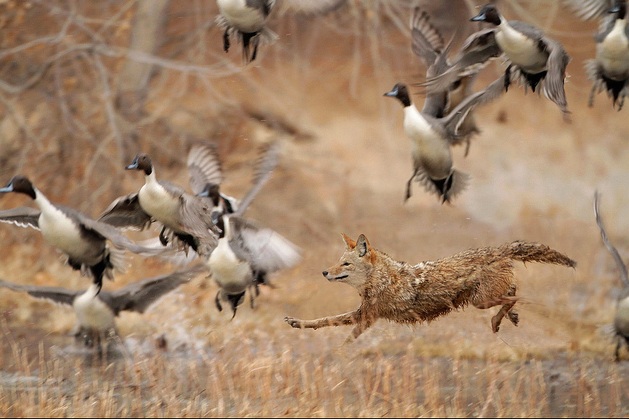 
Voting for anti-gun Democrats is dumber than giving treats to a dog that shits on a Persian Rug
|
|
|
|
|
Joined: Jan 2002
Posts: 10,238 Likes: 142
Sidelock
|
|
Sidelock
Joined: Jan 2002
Posts: 10,238 Likes: 142 |
the killing of predators is a long established game bird management technique practiced in europe for hundreds of years...it works there...why not here?
Last edited by ed good; 02/23/20 08:21 PM.
keep it simple and keep it safe...
|
|
|
|
|
Joined: Feb 2006
Posts: 1,609 Likes: 14
Sidelock
|
|
Sidelock
Joined: Feb 2006
Posts: 1,609 Likes: 14 |
Massachusetts recently published findings by Division of Fisheries and Game biologists in their publication "Massachusetts Wildlife" the results were that WNV has definitely had a negative impact on ruffed grouse populations in MA... however, through the course of their studies, not all infected birds succumbed to the disease... some birds had a natural resistance to it and survived. In blood tests on samples sent in by hunters they found antibody markers for fighting WNV. Lets hope they build up an immunity and begin to show a strong comeback. It will take years or decades for a resistant strain of ruffed grouse to begin to populate our favorite covers but there is hope.
Last edited by DAM16SXS; 02/23/20 08:36 PM.
|
|
|
|
|
Joined: Jan 2002
Posts: 14,108 Likes: 1879
Sidelock
|
|
Sidelock
Joined: Jan 2002
Posts: 14,108 Likes: 1879 |
the killing of predators is a long established game bird management technique practiced in europe for hundreds of years...it works there...why not here? Because of misplaced values by leftist tree hugger types who won't accept that one species may need to be controlled for the benefit of another. Their mantra is ........ leave 'em all alone. Yeah, right. How 'bout rats, mice and roaches? Oh, I see, they're exempt ............? SRH
May God bless America and those who defend her.
|
|
|
|
|
Joined: Jan 2002
Posts: 11,574 Likes: 167
Sidelock
|
|
Sidelock
Joined: Jan 2002
Posts: 11,574 Likes: 167 |
Larry, we had a lot of pheasants in the 90s and we had about the same amount of trapping (close to nothing) and probably even more predators, especially foxes. The loss of farmsteads and old barns and other outbuildings has dramatically reduced some predators like raccoons, skunks, and opossums. I don't know what the status of foxes are statewide, but around here they seem to be just coming back however slightly from a long hiatus.
Most people that study these things put a lot more emphasis on winter kill hens and especially spring nesting conditions.
Brent, coyotes tend to control fox populations. We had a lot of pheasants in the 90's due to CRP--especially all the "full field" variety, much of which we lost as a result of the 1996 Farm Bill. Overall CRP acreage, Iowa looks good comparatively speaking . . . but much of it is now in buffer strips as opposed to the big fields we had prior to the changes in the 96 Farm Bill. But stop to think how many MORE pheasants we would have had in the late 80's and 90's if trapping pressure had been what it was a couple decades earlier. Studies done by Delta Waterfowl have established that intensive trapping will increase waterfowl production on prairie potholes surrounded with decent habitat. Unfortunately, that doesn't work on the kind of "macro" scale that would be required to have a significant impact on upland bird numbers. But when we had that kind of trapping pressure simply because fur prices were higher and there were a lot more trappers, that helped to offset the fact that we didn't have all the really good habitat that existed in Iowa for about the first decade of CRP. With the push to larger farm fields, we've also lost a lot of the "micro" habitats--fencerows etc--that we used to have. Sort of a "death by a thousand cuts" situation. Farming in Iowa is far less diverse than it used to be--and it's hard to imagine that it's going to change much to benefit wildlife in the future. Barring programs from DC. And it doesn't appear likely that we're going to regain the 10 million acres or so of CRP that have been lost since peak enrollment. Iowa's grouse decline was mostly a habitat issue. Not much logging going on, and essentially no clear cutting. Same thing happened in SE Minnesota and SW Wisconsin. All those areas offered--at least through the 80's--very good grouse hunting. But the increase in nest predators was almost certainly a secondary factor where grouse were concerned as well. Back in 1987, when I was assigned to an Army Reserve unit at Ft McCoy, we had a female officer who was married to an active duty officer stationed there. He killed 20-some grouse hunting on post without a dog. That won't happen these days, sad to say. When the Iowa DNR finally got around to doing an inventory of the forests on public land, they found that the amount of early successional habitat was very small. They've tried to do edge management since then and have worked with private property owners surrounding public land on habitat improvement as well. But it's largely a case of too little and too late.
|
|
|
|
|
Joined: Oct 2009
Posts: 6,701 Likes: 616
Sidelock
|
|
Sidelock
Joined: Oct 2009
Posts: 6,701 Likes: 616 |
Larry, was just about to mention those Delta Waterfowl predator studies. I was working quite closely with Delta Waterfowl's HQ at the time (they were two blocks from my office in Winnipeg).
Last edited by canvasback; 02/24/20 11:45 AM.
The world cries out for such: he is needed & needed badly- the man who can carry a message to Garcia
|
|
|
|
|
Joined: Feb 2009
Posts: 7,714 Likes: 347
Sidelock
|
|
Sidelock
Joined: Feb 2009
Posts: 7,714 Likes: 347 |
....Back in 1987, when I was assigned to an Army Reserve unit at Ft McCoy, we had a female officer who was married to an active duty officer stationed there. He killed 20-some grouse hunting on post without a dog.... Good memories, I had a chance to hunt on and off at Ft. McCoy for a few years about that time. A buddy had a nice size plot of woods in the tiny town of Mill Pond. Sitting on various deer stands, the Drummer in the Woods show was almost always on display at half a stone's throw. Lots of Woodcock too and Wood ducks on the small water, haven't been in the area for quite a while.
|
|
|
|
|
Joined: Nov 2018
Posts: 116 Likes: 16
Sidelock
|
|
Sidelock
Joined: Nov 2018
Posts: 116 Likes: 16 |
The grouse began to disappear long before WNV came around. In Ct the decline of the grouse coincided with the re-introduction of the wild Turkey. The covers where I hunted are almost exactly the same now as they were 35 years ago. Wild grapes, plenty of berries and birch. The big difference is during the 80's there were no turkeys and plenty of grouse now there are no grouse and plenty of turkeys.
|
|
|
|
|
Joined: Nov 2015
Posts: 671 Likes: 57
Sidelock
|
|
Sidelock
Joined: Nov 2015
Posts: 671 Likes: 57 |
Of course predator control can work, but is very expensive and practical only on very small areas devoted to the production of a few, sometimes a single game species, not the general countryside.
A big part of the problem, at least with trying to increase duck nest success in the Prairie Pothole Region that I am familiar with, is that there are so many kinds of nest predators. Thus the predator control must be intensive, and that is nearly impossible now that the best tools like cyanide guns, poisoned grain, and strychnine drop baits are no longer legal for even professionals to use. Even then, there are obstacles like obtaining landowner permission to kill furbearers such as mink and kill cats that range out from farmsteads. Around here, studies show it takes many years to reduce populations of even the more common predators with normal methods like shooting, den cleanouts, trapping and winter aerial hunting, even on an area as small as 10 mi2. The neighbors just keep moving in to the unoccupied habitat created. Also keep in mind that once those duck eggs hatch and the ducklings complete the perilous trip to a suitable natal wetland, another suite of predators, mostly birds, begin to take their toll.
So in this intensively farmed region, I would rather see tax dollars spent on habitat creation or improvement and let individuals, hunting clubs, or conservation organizations control predators with private dollars on any land they have access to.
|
|
|
|
|
Joined: Jun 2015
Posts: 397 Likes: 12
Sidelock
|
|
Sidelock
Joined: Jun 2015
Posts: 397 Likes: 12 |
In my personnel observation an opinion here in Ohio, the strip mining and clear cutting has completely stopped. This method made great habitat and over the next 25 30 years the habitat changed. I also believe west Nile or some other plight has played a role in the decline of ruff grouse. Lastly Grouse hunters along with turkey hunter here in Ohio, have contacted DNR which falls on death ears due to the sales of hunting licenses. Heaven forbid licensing sales decline. The reality is licenses sales are declining, which has caused price to go out of sight for resident hunters.
Grouse hunting got me obsessed with SxS shotguns! I prey they bounce back but I have not heard a grouse drum in Ohio for more years than I can remember
|
|
|
|
|
Joined: Feb 2008
Posts: 11,837 Likes: 698
Sidelock
|
|
Sidelock
Joined: Feb 2008
Posts: 11,837 Likes: 698 |
Neither strip mining or clear-cutting has completely stopped in Ohio. Coal mining has diminished due to the anti-coal burning policies of anti-gun Democrats, but it has not stopped completely. There are several other minerals still actively mined in Ohio including limestone and dolomite, sand and gravel, sandstone and conglomerate, clay, shale, and salt. There is no doubt that there has been a shift in Ohio forests over the years. But that has always been true of forests everywhere. There is actually a large increase in forested land as a lot of former farm land is reverting back to wooded land. Overall, the forest has become more mature, but there is still a very active logging industry that includes both selective cutting and clear-cutting. Here's a pretty good breakdown of what is actually happening over the entire state: https://www.fs.fed.us/ne/newtown_square/publications/resource_bulletins/pdfs/scanned/OCR/ne_rb75.pdfAnd here is one of the recent complaints about the clear-cutting that often happens on both private and state lands: https://thenewpolitical.com/2017/02/21/opinion-clear-cutting-problem-trump-unlikely-fix/It is in succession stages of growth that we have the best grouse habitat, and there is still no shortage of early and mid-succession regrowth on logged out areas and abandoned farm land. I've also heard the nonsense about one very hard winter that virtually eliminated quail in southern Ohio in the late 1970's. If that was the only cause, it would seem that it should be fairly easy to re-establish a breeding population when the country is supposedly in a global warming trend. I have not hunted in Ohio for about 10 years, but I can say there is a lot of very thick cover and good habitat in the eastern part of Ohio. Southeast Ohio has some of the thickest cover imaginable, and the areas I hunted had large areas of immature trees along with memorable amounts of blackberries and multiflora rose thickets. I do not think the tremendous decline of ruffed grouse in Ohio (or Pennsylvania) has anything at all to do with a lack of good habitat, either because there is no logging, or because small farms have largely been replaced with the huge monocrop type of farming seen in the midwestern states. I won't say that West Nile Virus is not a factor. But I know the big decline started well before we ever heard of WNV. It was easy to place the blame on the 11 year population cycle of ruffed grouse. But when the peak years came back and there were still very few grouse, it became apparent that we had a serious problem.
Voting for anti-gun Democrats is dumber than giving treats to a dog that shits on a Persian Rug
|
|
|
|
|
Joined: Dec 2012
Posts: 3,667 Likes: 1103
Sidelock
|
|
OP
Sidelock
Joined: Dec 2012
Posts: 3,667 Likes: 1103 |
I'm perplexed. I'm fairly certain northern Minnesota has both raptors and coyotes (and even wolves where I'm hunting). Heck, I've even personally seen at least two Fisher cats on the trails up there and yet...the birds seem to be doing quite well. I would venture to guess that West Nile is even up there as well. What am I missing here? I have read that certain species require a minimum population density to propagate successfully, a "tipping point" of sorts. Is that a possible explanation? I do know that Minnesota birds are the Canadian varient (Bonasa ????, which is slightly bigger and more grey-phase dominant) could that be a factor?
Last edited by Lloyd3; 02/25/20 05:51 PM.
|
|
|
|
|
Joined: Jan 2004
Posts: 7,597 Likes: 657
Sidelock
|
|
Sidelock
Joined: Jan 2004
Posts: 7,597 Likes: 657 |
I'm perplexed. I'm fairly certain northern Minnesota has both raptors and coyotes (and even wolves where I'm hunting). Heck, I've even personally seen at least two Fisher cats on the trails up there and yet...the birds seem to be doing quite well. I would venture to guess that West Nile is even up there as well. What am I missing here? I have read that certain species require a minimum population density to propagate successfully, a "tipping point" of sorts. Is that a possible explanation? I do know that Minnesota birds are the Canadian varient (Bonasa ????, which is slightly bigger and more grey-phase dominant) could that be a factor "Tipping point," also called an Allee effect, is when the system (in this case roofed grouse numbers) is drawn so far from their normal equilibrium that they cannot recover and drift towards a new equilibrium which can be a smaller or greater number or none at all. Definitely UNlikely in this case unless numbers get VERY low. Northern MN has always been full of predators, but roofed grouse numbers have always been more reflective of things like winter/spring weather, ice storms, and so on. Whether West Nile is up there, I don't know. It certainly seems likely. It appears to be almost everywhere at some level now. Armchair declarations of what is wrong with any wildlife population is likely to be wrong more often than not. Not that such a detail like that could ever affect the internet from pontificating. Someday soonish I need to get back up there and chase them again, before I'm dogless or kneeless.
_________ BrentD, (Professor - just for Stan) =>/
|
|
|
|
|
Joined: Jan 2002
Posts: 10,238 Likes: 142
Sidelock
|
|
Sidelock
Joined: Jan 2002
Posts: 10,238 Likes: 142 |
northern mn and northern me are too cold too long to support wild turkey infestations...bottom line, less turkeys means more grouse...
keep it simple and keep it safe...
|
|
|
|
|
Joined: Jan 2002
Posts: 11,574 Likes: 167
Sidelock
|
|
Sidelock
Joined: Jan 2002
Posts: 11,574 Likes: 167 |
the killing of predators is a long established game bird management technique practiced in europe for hundreds of years...it works there...why not here? Ed, that's because in Europe, they've traditionally employed game keepers (sometimes even with assistants to help them) who shoot or trap anything that might kill a game bird. (Raptors are now protected . . . but as a Scottish keeper once told me: "Aye, they are . . . but they often meet with terrible accidents!") Traditionally, this was to provide the highest quality sport on His Lordship's estate. Today, with driven shooting being a business, it's to provide the highest quality sport to the paying customers. Previously, His Lordship paid the cost of predator control. Today, those who shoot driven birds pay for predator control. I haven't hunted northern MN so can't comment on turkey numbers. But they're all over the place in northern WI. It's my understanding that the WI DNR thought the state would never have turkeys north of Highway 8. I live north of Highway 8 and I have a flock that wanders through my yard frequently. For that matter, they're quite common in Michigan's UP. Part of the reason, I think, is people who put out corn and other food for deer in the winter. I'm sure the turkeys also take advantage of that. In the USA, we were fortunate for a long time to get predator control for free, courtesy of trappers and furbearer hunters. Currently, as suggested elsewhere, it's become politically incorrect to value one species above another--even though it's the game species rather than the predators that pay the bill where wildlife is concerned. Which means, to me, that game species are clearly "more valuable" than the critters that kill them or destroy their nests.
Last edited by L. Brown; 02/26/20 07:35 AM.
|
|
|
|
|
Joined: Jan 2002
Posts: 10,238 Likes: 142
Sidelock
|
|
Sidelock
Joined: Jan 2002
Posts: 10,238 Likes: 142 |
too bad none of our state hunting licensing fees and federal excise taxes are used for game bird predator control...
keep it simple and keep it safe...
|
|
|
|
|
Joined: Feb 2009
Posts: 7,714 Likes: 347
Sidelock
|
|
Sidelock
Joined: Feb 2009
Posts: 7,714 Likes: 347 |
I have seen quite a few turkey incidentally in Montana, both out on the plains and up to about seven thousand feet in the mountains. They seem to hold up just fine to some wintery conditions. I don't know what the harvest numbers are, but long range recreational shooting seems to have created a predator hunting trend, at least for coyotes.
|
|
|
|
|
Joined: Dec 2012
Posts: 3,667 Likes: 1103
Sidelock
|
|
OP
Sidelock
Joined: Dec 2012
Posts: 3,667 Likes: 1103 |
Good point as there are no turkeys where I'm hunting grouse. Interesting...
Last edited by Lloyd3; 02/26/20 12:07 PM.
|
|
|
|
|
Joined: Jan 2004
Posts: 7,597 Likes: 657
Sidelock
|
|
Sidelock
Joined: Jan 2004
Posts: 7,597 Likes: 657 |
Good point as there are no turkeys where I'm hunting grouse. Interesting... Don't say that! Don't want to break up the internet mythology that deer and turkeys and god know what all, are responsible for quail/grouse/pheasant/whatever declines (along with the always, and ubiquitous, dumber-than-rocks game management biologists).
_________ BrentD, (Professor - just for Stan) =>/
|
|
|
|
|
Joined: Dec 2012
Posts: 3,667 Likes: 1103
Sidelock
|
|
OP
Sidelock
Joined: Dec 2012
Posts: 3,667 Likes: 1103 |
Well....the only difference I can point-to between the two scenarios, other than significantly more-severe winters, would be the complete absence of wild turkeys. There used to be moose up there as well but a pestilence known locally as "brain-worm" seems to have eradicated them. There also aren't any quail locally, but there are sharptails if that means anything. There was an episode on "Nature" a while back that was titled "My life as a turkey". Besides it being a beautifully well-done story about a wildlife biologist raising a flock of wild birds in Florida and keeping them wild, it made me keenly aware of just how voraciously efficient they are at foraging. Anything small in their path was fair game as they would vacuum-up anything and everything they came across.
Last edited by Lloyd3; 02/26/20 01:35 PM.
|
|
|
|
|
Joined: Jan 2002
Posts: 7,726 Likes: 129
Sidelock
|
|
Sidelock
Joined: Jan 2002
Posts: 7,726 Likes: 129 |
LLoyd, there's a good book that Nature episode is based on."Illumination in the Flatwoods"...Geo
|
|
|
|
|
Joined: Jan 2002
Posts: 10,238 Likes: 142
Sidelock
|
|
Sidelock
Joined: Jan 2002
Posts: 10,238 Likes: 142 |
keep it simple and keep it safe...
|
|
|
|
|
Joined: Nov 2015
Posts: 671 Likes: 57
Sidelock
|
|
Sidelock
Joined: Nov 2015
Posts: 671 Likes: 57 |
And to think Ben Franklin proposed those terrible omnivores for our National Bird! Instead we ended up with a carnivore.
|
|
|
|
|

