August
S M T W T F S
1
2 3 4 5 6 7 8
9 10 11 12 13 14 15
16 17 18 19 20 21 22
23 24 25 26 27 28 29
30 31
Who's Online Now
4 members (OldMaineWoodsman, Carcano, 2 invisible), 1,228 guests, and 7 robots.
Key: Admin, Global Mod, Mod
Forum Statistics
Forums10
Topics40,336
Posts574,016
Members14,700
Most Online32,084
Jun 14th, 2026
Previous Thread
Next Thread
Print Thread
Page 3 of 4 1 2 3 4
Joined: Dec 2001
Posts: 12,743
Sidelock
***
Offline
Sidelock
***

Joined: Dec 2001
Posts: 12,743
Argo;
Does the gun in question indeed have any choke in either barrel? The Not for Ball mark was to be used only if the barrel had as much as .008" constriction, or essentially a choke. A cylinder or improved cylinder barrel would thus not be marked.

Also, it is a very good possibility that even if it is choked the "Proofer" simply failed to stamp the NFB mark. I think such goofs on the part of the proof houses are far more common than we like to think. This would be particularly evident near a change in the marks. Of course, the date the gun was proofed is not the date the gun was completed & ready to be sold.


Miller/TN
I Didn't Say Everything I Said, Yogi Berra
Joined: Feb 2016
Posts: 3,809
Likes: 626
Sidelock
**
Offline
Sidelock
**

Joined: Feb 2016
Posts: 3,809
Likes: 626
Miller, 19286 apparently had chokes. I'll post the photos from the site. I thought the analysis from "Tiger" was first rate. The line was posted here: https://www.internetgunclub.com/archived-forum/posts.php?topicid=1344 You'll note it was reproofed in 2004:
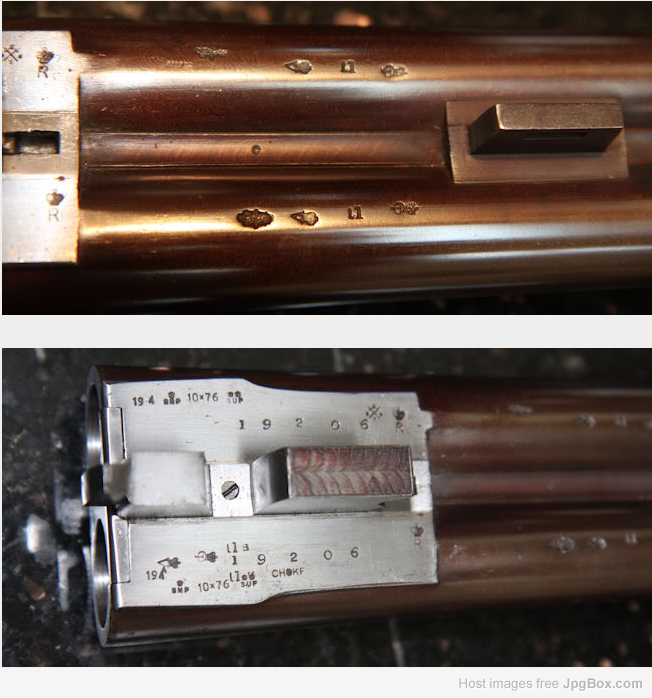

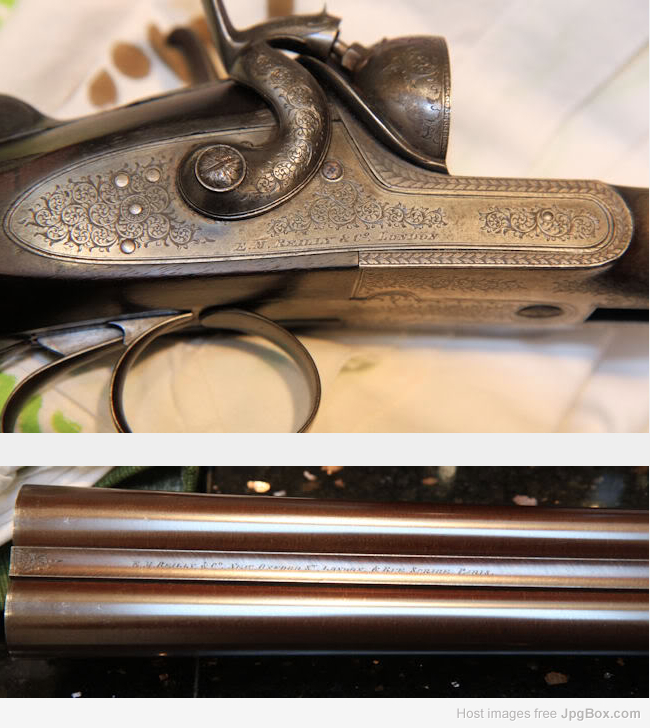


Larry, the chart on Reilly SN's is subjective by nature;

-- You can't know when a gun was actually Serial Numbered for instance - I've assumed that Reilly like William Evans and other London dealers, Serial Numbered their guns when they were ordered; but there's a chance Reilly sold guns off the rack already serial numbered or more likely they serial numbered them when sold.
. . . . .- For instance Terry Lubinski's Reilly SN 303xx was per the chart SN'd in very early 1889, late 1888 - yet the barrel has "not for ball."
. . . . .- A gun sold by Toby Barclay 35079 was proofed pre-1896 but the SN places it at late 1900.
. . . . .- 26584 was serial numbered in late 1884 yet on the label "1886" is written.
. . . . .- 13599 was serial numbered in very late 1864; yet there is "Sanskrit" writing on it that reads, "Maharaj Pratap Singh ji Solarkar or Sarkar Palamau. Vaishak..(i.e April/May) Sudi 12 means 12 of April/ May..Sanwat 1937" (dating to 1880 in the Georgian calendar). "200 Silvers rupees paid to the seller along with some presentation." (i.e. it was probably resold in India in 1880).

-- I don't know when Reilly built gun 001; or if there were a 001.

-- Proof marks and Patent numbers can't prove anything; guns were redone, updated - rebounding hammers added.
. . . . . .- SN 10354, which would date from mid-1857, was completely redone between 1895 and 1904 including new receiver, action, stock, hammers, etc. and may have been converted from a Muzzle Loader to a breech loader at that time.
. . . . . .- SN 34585 was 1898 - yet it has steel barrels with the 295 Oxford St. address on them (post 1904) - it likely was re-barreled.

-- Labels change - cases are re-lined.

-- Even addresses on ribs might not be accurate -
. . . . . .- the numbering system on Oxford Street changed in November 1881, yet you can still find guns and newspaper advertisements using the old numbering system for a couple of years afterwards.
. . . . . .- 3402, Terry Buffum's gun, was sold as an "E.M. Reilly." It surely had to have had J.C. Reilly on the rib. Terry thought perhaps the auction house didn't know who was Joseph Charles and just assumed it was the more famous "E.M."

-- But the chart does use some firm data - If a gun has "rue Scribe" on it - it had to be numbered after the opening of that store in mid-February 1868. So the number chart is subjective but is based on concrete observations. (And how do I know rue Scribe opened around 12 Feb 1868? - it's all laid out in the Reilly line).

-- What patent numbers and proof marks can do though is subjectively add some "Sanity Checks" to the chart. The data has to be interpreted but it helps.
. . . . .- For instance in the UK analysis of 19286, the H.Walker patent use marks were helpful in confirming what I had already postulated. Anson & Deeley use marks may prove to also help confirm data from the 1880's.
. . . . .- SN 11115 is the first gun found with "EM Reilly" on the rib. It can't date before October 1859 when that name first began to be used for the company; the chart has it as late 1859. 11115 also has a Jones underlever - Jones patent was Sept 1859. The patent number and the gun date fit.

Admittedly the Reilly research was Quixotic - but there isn't anything better out there I don't think.

Last edited by Argo44; 11/24/18 11:51 PM.

Baluch are not Brahui, Brahui are Baluch
Joined: Dec 2001
Posts: 12,743
Sidelock
***
Offline
Sidelock
***

Joined: Dec 2001
Posts: 12,743
Argo;
Do you know what the muzzle diameters of this gun (#19286) are? it was originally proofed as an 11 gauge which means it would accept a .751" plug gage but not a .775" one. At reproof, it was proofed with 19.4 mm bores (.764"). At reproof, only the left flat is marked choke. "IF" at original proof, the barrels had less than .008" of choke they would not have been marked not for ball, even after 1875.

There is one other scenario & I truly do not know how this was handled. Original proof was for 11 gauge. Chamber was not marked, only the bore. Let's assume the .763" bores at re-proof were "Original". "BUT" the proof house did not actually measure the bore size at that time, only knew it would take a .751" plug but not a .775" one. So how did they determine at what muzzle size to mark "Not For Ball". My "Guess" & this is only a guess, is they had plug gages made up .008" smaller than each gage size. This plug would have been .743" diameter. It could thus have had about .020" constriction, but would not have needed to be marked as it would be safe with a ball intended for an 11 gauge bore. It would not have been safe with a ball intended for a 10 gauge bore, but nothing on the gun stated it was, in fact, a 10 gauge. Even though it chambered a 10 gauge shell, the bores were 11 gauge & so marked. Just a little food for thought.


Miller/TN
I Didn't Say Everything I Said, Yogi Berra
Joined: Feb 2016
Posts: 3,809
Likes: 626
Sidelock
**
Offline
Sidelock
**

Joined: Feb 2016
Posts: 3,809
Likes: 626
I can't really answer that...all I know about the gun was contained in the posted thread. What is for sure is that I've learned a lot from you and Toby and Larry already. Thanks. Gene Williams


Baluch are not Brahui, Brahui are Baluch
Joined: Jan 2002
Posts: 11,575
Likes: 182
Sidelock
**
Offline
Sidelock
**

Joined: Jan 2002
Posts: 11,575
Likes: 182
Reading from the rules of 1875, I don't find any minimum amount of choke required for barrels that were to be marked NFB. All of them were to be so marked, the only exception being those with recessed chokes. On those, the word "choke" was substituted for NFB. (And that's the first time the word "choke" appeared as a proofmark--although with a very different meaning that it had under later proof rules.)

Under the rules of 1887, "choke" replaced NFB on all choke-bored barrels, finally abolishing "not for ball". The exact meaning of "choke", however, was changed again under the rules of 1904. Under those rules, barrels with a constriction of .008 or more HAD to be marked "choke". But they could--at the request of the sender--be marked "choke" if they had at least .004 constriction.

So once again our British cousins confuse us with 3 different meanings for the "choke" proofmark . . . depending on when the gun was made.

Joined: Feb 2016
Posts: 3,809
Likes: 626
Sidelock
**
Offline
Sidelock
**

Joined: Feb 2016
Posts: 3,809
Likes: 626
Recessed chokes? Hummm. A trip to the internet is confusing. It appears that the barrel was cylinder bored - then 2 to 4 inches of the end of the barrel was recessed by a special tool? Like this??
. . . . . . . . cross-section
. . Barrel. . . . Recess. . . .Muzzle
_________________________
_____________/--------\____|
.
.
-------------------\______/-----|
-----------------------------------|

Now curiosity is definitely killing the cat. So how prevalent were chokes from the 1866 Pape patent to the introduction of NFB in 1875? When did "Choke" begin to be stamped? I've looked at and dated a lot of Reilly's but most of them had no pics of the barrel flats.

Last edited by Argo44; 11/24/18 11:49 PM.

Baluch are not Brahui, Brahui are Baluch
Joined: Dec 2001
Posts: 12,743
Sidelock
***
Offline
Sidelock
***

Joined: Dec 2001
Posts: 12,743
Actually between 1875 & 1887 was the period of time a choke bore barrel was marked with a bore & muzzle diameter stamp. A typical mark would have been 11B/13M ( the / is the only way I have to denote a fractional marking). This was along with the Not For Ball stamp.

On a barrel so marked it would have been extremely inadvisable to use a ball made for a Cylinder bored 11 gauge, but one sized for a 13 gauge bore would be fine.

If the gun were cylinder bored then it would only carry one stamp for the bore & have neither the mark for the muzzle nor the Not For Ball mark. My old Birmingham proofed W Richards is so marked. It is definitely pre 1887 as it does not have the chamber mark. It is cylinder bore in both barrels & is only marked 14, though it has 12 gauge chambers. It is possible it was made prior to 1875, but I really do not think so.

Prior to the general acceptance of choke boring, I believe that most guns, even the breech loaders, were gauged at the muzzle by the proof houses.


Miller/TN
I Didn't Say Everything I Said, Yogi Berra
Joined: Jan 2002
Posts: 11,575
Likes: 182
Sidelock
**
Offline
Sidelock
**

Joined: Jan 2002
Posts: 11,575
Likes: 182
Originally Posted By: Argo44
Recessed chokes? Hummm. A trip to the internet is confusing. It appears that the barrel was cylinder bored - then 2 to 4 inches of the end of the barrel was recessed by a special tool? Like this??
. . . . . . . . cross-section
. . Barrel. . . . Recess. . . .Muzzle
_________________________
_____________/--------\____|
.
.
-------------------\______/-----|
-----------------------------------|

Now curiosity is definitely killing the cat. So how prevalent were chokes from the 1866 Pape patent to the introduction of NFB in 1875? When did "Choke" begin to be stamped? I've looked at and dated a lot of Reilly's but most of them had no pics of the barrel flats.


No idea how popular choke-bored guns were during that decade. The recessed choke is probably more commonly referred to as a jug choke.

When did "choke" begin to be stamped? Well, the rules of 1875 were published by both proof houses on October 11 of that year. Quoting from the 1875 rules, referring to the recessed/jug choked barrels:

"As to every such barrel, the word CHOKE shall be substituted for the words NOT FOR BALL in the proof mark aforesaid, but in all other respects the marks denoting definitive proof of choke-bored barrels of every description shall be identical."

I'd say that's about as specific as you're likely to find. So, from 11 October 1875 forward (until the rules were changed in 1887), that's the way the proof houses would have marked barrels.

Last edited by L. Brown; 11/25/18 09:22 AM.
Joined: Dec 2001
Posts: 12,743
Sidelock
***
Offline
Sidelock
***

Joined: Dec 2001
Posts: 12,743
The substitution of the word choke rather than "not for ball" in the case of the recessed choke is rather obvious. The solid ball did not expand when passing through the recess thus presented no problem in going through the "Choke".

The whole bottom line was any solid ball fired needed to be of a small enough size to pass through the choke. At this point in time, the solid round ball was the most common projectile used in a shotgun for larger game. A solid ball larger than the choke diameter becomes an obstruction & can cause a bulge, or what the British called "Lift the Choke".


Miller/TN
I Didn't Say Everything I Said, Yogi Berra
Joined: Feb 2016
Posts: 3,809
Likes: 626
Sidelock
**
Offline
Sidelock
**

Joined: Feb 2016
Posts: 3,809
Likes: 626
I'm still a little confused and the internet isn't helping. Was the NFB stamp requirement instituted in both proof houses at the same time as "CHOKE" (11 Nov 1875), or did stamping the flats with "NFB" come first then a few months later "CHOKE" supplemented or complemented it? Larry's post above makes it seem as if NFB was already being stamped - then it was decided that "CHOKE" could be substituted for it.

(I do note that in "Tiger"'s analysis of Reilly 19286, he commented on the H.Walker patent use number, but also on the fact the gun had neither NFB, nor "CHOKE" (although there is clearly a "choke" marked on the left barrel).

As I understand it Greener worked pretty much throughout 1874 on perfecting the choke concept (originally an American idea) - Greener's choke bore was first mentioned in Dec 1874 then ran the tables at "The Field" trials in 1875 - which is presumably why the proof houses acted.

Last edited by Argo44; 11/25/18 10:38 PM.

Baluch are not Brahui, Brahui are Baluch
Page 3 of 4 1 2 3 4

Link Copied to Clipboard

doublegunshop.com home | Welcome | Sponsors & Advertisers | DoubleGun Rack | Doublegun Book Rack

Order or request info | Other Useful Information

Updated every minute of everyday!


Copyright (c) 1993 - 2026 doublegunshop.com. All rights reserved. doublegunshop.com - Bloomfield, NY 14469. USA These materials are provided by doublegunshop.com as a service to its customers and may be used for informational purposes only. doublegunshop.com assumes no responsibility for errors or omissions in these materials. THESE MATERIALS ARE PROVIDED "AS IS" WITHOUT WARRANTY OF ANY KIND, EITHER EXPRESS OR IMPLIED, INCLUDING BUT NOT LIMITED TO, THE IMPLIED WARRANTIES OF MERCHANT-ABILITY, FITNESS FOR A PARTICULAR PURPOSE, OR NON-INFRINGEMENT. doublegunshop.com further does not warrant the accuracy or completeness of the information, text, graphics, links or other items contained within these materials. doublegunshop.com shall not be liable for any special, indirect, incidental, or consequential damages, including without limitation, lost revenues or lost profits, which may result from the use of these materials. doublegunshop.com may make changes to these materials, or to the products described therein, at any time without notice. doublegunshop.com makes no commitment to update the information contained herein. This is a public un-moderated forum participate at your own risk.

Note: The posting of Copyrighted material on this forum is prohibited without prior written consent of the Copyright holder. For specifics on Copyright Law and restrictions refer to: http://www.copyright.gov/laws/ - doublegunshop.com will not monitor nor will they be held liable for copyright violations presented on the BBS which is an open and un-moderated public forum.

Powered by UBB.threads™ PHP Forum Software 7.7.5