|
S |
M |
T |
W |
T |
F |
S |
|
|
1
|
2
|
3
|
4
|
5
|
6
|
|
7
|
8
|
9
|
10
|
11
|
12
|
13
|
|
14
|
15
|
16
|
17
|
18
|
19
|
20
|
|
21
|
22
|
23
|
24
|
25
|
26
|
27
|
|
28
|
29
|
30
|
31
|
|
|
|
|
|
Forums10
Topics39,709
Posts564,481
Members14,611
| |
Most Online9,918
Jul 28th, 2025
|
|
|
|
Joined: Mar 2005
Posts: 709
Sidelock
|
OP

Sidelock
Joined: Mar 2005
Posts: 709 |
I like French guns but they seem to have badly pitted bores more frequently then guns from other countries. Is it due to corrosive primers or poor cleaning practices on the part of the owner?
|
|
|
|
|
Joined: Feb 2002
Posts: 2,859
Sidelock
|
|
Sidelock
Joined: Feb 2002
Posts: 2,859 |
I'm partial to French guns as well. I've owned three, looked at quite a few more, and none of them have had pitted bores. Maybe you've been unlucky or you've just been hanging out in a bad neighborhood  . Steve
Approach life like you do a yellow light - RUN IT! (Gail T.)
|
|
|
|
|
Joined: Jan 2002
Posts: 11,574 Likes: 167
Sidelock
|
|
Sidelock
Joined: Jan 2002
Posts: 11,574 Likes: 167 |
Pooch, I'd say more likely corrosive primers than anything else. You don't see it nearly as often on Brit guns, especially not nicer boxlock or sidelock ejector guns. But that may be because the Brits had a periodic maintenance habit with their guns--sending them off to the maker or a good gunsmith after the season for a good going over, which would have included a bit of polishing and honing if necessary. I also think the French had a higher percentage of more basic guns than the Brits--more like us in this country, or what the Brits might have called "keeper's guns"--that only received attention from a smith if something broke.
|
|
|
|
|
Joined: Jul 2002
Posts: 1,619 Likes: 7
Sidelock
|
|
Sidelock
Joined: Jul 2002
Posts: 1,619 Likes: 7 |
German Guns seem to have barrels in better condition than French Guns, in my experience. The Teutonic attention to detail perhaps ?
Mine's a tale that can't be told, my freedom I hold dear.
|
|
|
|
|
Joined: Mar 2005
Posts: 709
Sidelock
|
|
OP
Sidelock
Joined: Mar 2005
Posts: 709 |
I've noticed that also about German guns.
|
|
|
|
|
Joined: Aug 2003
Posts: 386 Likes: 1
Sidelock
|
|
Sidelock
Joined: Aug 2003
Posts: 386 Likes: 1 |
Pooch, You beat me to this question by about a day. My friend and I were talking Friday afternoon about French shotguns. We both like them but it seems that it is hard to find one that has good bores.
I told him I would post the question on this sight, and maybe get a little education.
Dave
|
|
|
|
|
Joined: Jan 2002
Posts: 5,954 Likes: 15
Sidelock
|
|
Sidelock
Joined: Jan 2002
Posts: 5,954 Likes: 15 |
Does the postulated predikument occur with all guns used in France or has it primarily to do with guns of French make and used in France? How about French guns exported and used elsewhere?
DDA
|
|
|
|
|
Joined: May 2011
Posts: 1,071
Sidelock
|
|
Sidelock
Joined: May 2011
Posts: 1,071 |
My Darne has pitted bores. But I don't know the history of it so I don't know if it's because it saw a lot of use in France or if it's due to poor maintenance.
|
|
|
|
|
Joined: Mar 2005
Posts: 709
Sidelock
|
|
OP
Sidelock
Joined: Mar 2005
Posts: 709 |
I was hoping somebody here could tell me why or if my own experience was inconsistent with everybody else.
|
|
|
|
|
Joined: Feb 2002
Posts: 2,859
Sidelock
|
|
Sidelock
Joined: Feb 2002
Posts: 2,859 |
I was hoping somebody here could tell me why or if my own experience was inconsistent with everybody else. As I said earlier, your experience is inconsistent with mine. Steve
Approach life like you do a yellow light - RUN IT! (Gail T.)
|
|
|
|
|
Joined: Mar 2005
Posts: 709
Sidelock
|
|
OP
Sidelock
Joined: Mar 2005
Posts: 709 |
Hopefully we will learn more.
|
|
|
|
|
Joined: May 2011
Posts: 766 Likes: 2
Sidelock
|
|
Sidelock
Joined: May 2011
Posts: 766 Likes: 2 |
Several I have seen were deeply pitted, as well...perhaps the metalurgy? Steve
|
|
|
|
|
Joined: Nov 2006
Posts: 534
Sidelock
|
|
Sidelock
Joined: Nov 2006
Posts: 534 |
Two factors there.
Most French SxS users pre war are of the "farmer" type that used the gun often, and probably did not clean much.
The common European rabbit "Oryctolagus cuniculus" was a pest until the 60s, and was a very common and ubiquitous target. Not to mention that it is very good eating. A common foe of the French farmer that was shot at at all times.
Added to that was WWII in which lots of shotguns were buried to avoid Nazi confiscation.
Some did well, the vast majority did not. Of course the outside would be damaged too in those cases.
I believe that a lot of the French shotgun found here came through Germany and were liberated by GIs in 1945.
I don't know if there was anything nefarious in "Poudre T" or the primers used.
Best regards,
WC-
|
|
|
|
|
Joined: Jan 2002
Posts: 11,574 Likes: 167
Sidelock
|
|
Sidelock
Joined: Jan 2002
Posts: 11,574 Likes: 167 |
The two most common issues I've seen with French guns are pitted bores and heavy triggers. Not that you won't find French guns with good bores and very nice triggers, but having looked at a bunch of them over the last 35+ years, I'd say both of those are more common with French guns than with doubles from any other country that produced a significant volume of guns. On the other hand, it's very unusual to find a French gun that isn't well-made. Certainly more common to find "crappers" from Belgium and Spain.
Rocketman, the problem with evaluating French guns made for export is that not very many fall into that category. Manufrance was the real volume maker of French doubles, and they never made a very concerted effort to penetrate the American market. The French were well behind the British, Germans, Belgians, Italians and Spanish in that area.
|
|
|
|
|
Joined: Jan 2010
Posts: 1,373 Likes: 6
Sidelock
|
|
Sidelock
Joined: Jan 2010
Posts: 1,373 Likes: 6 |
Here are some pages from a 1922 Verney-Carron catalog, discussing the grades of steel used in their barrels. They are in French, unfortunately, and my high school French and limited schedule have kept me from any serious effort to translate. I can email a jpg to anyone interested if the type is not legible. 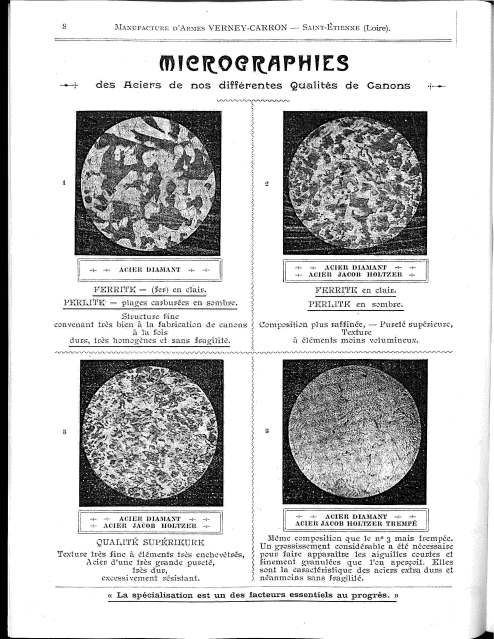 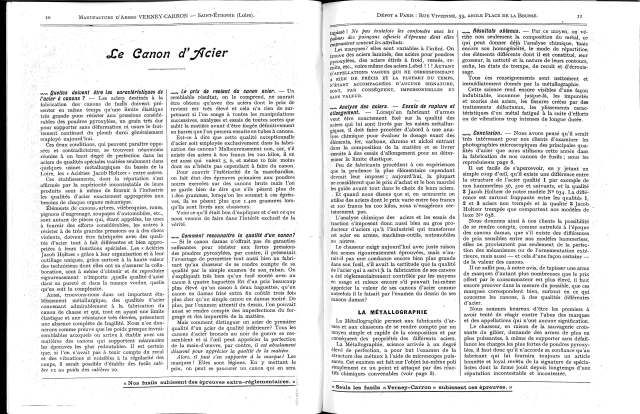 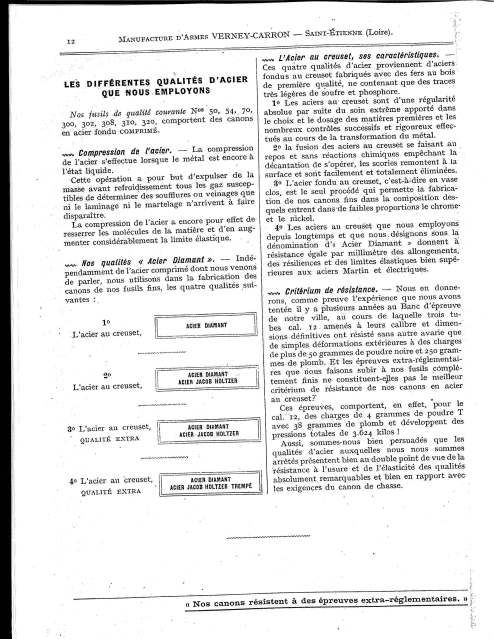
Such a long, long time to be gone, and a short time to be there.
|
|
|
|
|
Joined: May 2011
Posts: 1,219 Likes: 28
Sidelock
|
|
Sidelock
Joined: May 2011
Posts: 1,219 Likes: 28 |
I've seen far more French guns with pitted bores than without. I think it's a combination of the metallurgy, corrosive primers, and the relatively damp climate of rural France. I suspect, also, that the mercury salts in corrosive primers worked their way into the steel and stuck around longer than one cleaning.
I know with my French gun, liberated from a Norman barn in the summer of '44 and well-maintained since such that it has bright bores, that if I take it out on a damp day I had better clean it on returning to the house (as soon as it warms up) because I will see some red rust coming out on the patch if I wait even a day. And that's using contemporary shells.
fiery, dependable, occasionally transcendent
|
|
|
|
|
Joined: Jan 2002
Posts: 11,574 Likes: 167
Sidelock
|
|
Sidelock
Joined: Jan 2002
Posts: 11,574 Likes: 167 |
Dover, I'd be interested. Email: ljoelbrown@gmail.com.
It's February. Good time to play around with my "gun French".
|
|
|
|
|
Joined: Jan 2013
Posts: 2
Boxlock
|
|
Boxlock
Joined: Jan 2013
Posts: 2 |
The pitting may be holding enough crud/copper to make complete removal very difficult. I'd clean as long as my patience held, shoot some rounds, clean and compare the difference; may give you an idea about how much more "deep cleaning" needs to be done.
|
|
|
|
|
Joined: Dec 2012
Posts: 3,667 Likes: 1103
Sidelock
|
|
Sidelock
Joined: Dec 2012
Posts: 3,667 Likes: 1103 |
I was in St. Marys, Pennsylvania in late December of the past year (mostly warming up from a somewhat futile early morning, deep-snow hunt for snowshoe hares). While killing some time haunting the local gunshops (with tightly controlled expectations!) I ran across a French gun that looked very much like a Darne(I can't recall the maker just now, it wasn't Bruchet either). It seemed to be very well made and looked like it might have some potential for adoption until I got it into enough light to see down the tubes. Egads! It wasn't pitted, it was cratered! How the exterior and action of the gun could look so presentable and the tubes could be so deplorable was a stunner for me. It has to be the metallurgy. I simply don't see better-made guns from other nationalities having such a problem.
|
|
|
|
|
Joined: Mar 2005
Posts: 709
Sidelock
|
|
OP
Sidelock
Joined: Mar 2005
Posts: 709 |
I've never seen a French gun that had been sleeved. Perhaps they just shipped the bad barrels here instead of repairing them.
|
|
|
|
|
Joined: Dec 2012
Posts: 3,667 Likes: 1103
Sidelock
|
|
Sidelock
Joined: Dec 2012
Posts: 3,667 Likes: 1103 |
It was a Charlin (flat couldn't remember the name earlier). Really stood out on a rack full of Remingtons, Mossbergs and CZs. Not a damascus gun either and not obviously abused. The action was smooth as silk. A shame, really. I've seen some very intriguing French Gun designs (the Manufrance Ideal comes to mind)so I know they can make exceptional bird guns.
|
|
|
|
|
Joined: Jan 2002
Posts: 10,863 Likes: 1472
Sidelock
|

Sidelock
Joined: Jan 2002
Posts: 10,863 Likes: 1472 |
France has been over-run in not one, but, two world wars. On both occasions, guns that should have and would have seen good care, didn't. Petro chemicals of any nature were in short supply, and the guns that were retained by natives were often stored off site, so as to avoid prosecution if they were discoverd by the Hun or the later Nazis.
I've read of one shotgun that rode out both wars stored in a living tree. I'd expect it's condition reflects that.
Having a gun while occupied might have meant the difference between starvation and seeing the end of hostilities. Desperate circumstances seldom leave energy for the consideration of belongings and the associated maintenance. I've also read of loads for guns comprised of bits of glass, broken nails, or salvaged ball bearings.
If you needed a meal, you might not care what the specifics of the load you used were.
Speaking only for Darne produced guns, the specific steels used for production since about the mid 1930s were XT, for non magnum guns, and XTC, a French version of 4140, used for everything else. They are both very, very good gun steels, and I assume other makers were using something similar. The chrome content on XTC makes it difficult to blue. Both Stoeger and James Wayne offered a stainless steel barrel option on Darne guns in their catalogs, something I've never seen in person.
I've seen plenty of French and English guns with pitted bores. I've seen more English guns that had honing done to remove pits. I'm not sure honing benefits anyone but a seller, especially if he can convince a buyer that the bores look as they did when new.
Best,
Ted
|
|
|
|
|
Joined: Jan 2002
Posts: 296 Likes: 14
Sidelock
|
|
Sidelock
Joined: Jan 2002
Posts: 296 Likes: 14 |
I have an older Darne 16 gauge with pitted to cratered bores. It has old property numbers stamped in the wood reflecting either military service or police evidence at some point in its life.
I have always assumed it might have been to Vietnam based on the bores. The wood and exterior metal look fine.
It shoots fine as well with factory 2 3/4 Remington game loads, I assume the bores look worse than the reality.
|
|
|
|
|
Joined: Dec 2012
Posts: 3,667 Likes: 1103
Sidelock
|
|
Sidelock
Joined: Dec 2012
Posts: 3,667 Likes: 1103 |
I would have had serious reservations about shooting the Charlin I saw. Minor pitting is one thing, but big craters are something else. I know that pressure drops off significatly as the shot charge makes its way down the bore, but craters are indicative of almost no metal being left in a barrel wall at that point. Moreover, the condition of the entire barrel would be in question for me, with a burst failure being possible at any location.
|
|
|
|
|
Joined: May 2011
Posts: 1,219 Likes: 28
Sidelock
|
|
Sidelock
Joined: May 2011
Posts: 1,219 Likes: 28 |
In its Vietnam section on the guns of America's wars, the NRA Museum has a Darne, cut down some, with the notation that they were well-liked in French Indochina because the strength of the action allowed them to close easily when fed humidity-swollen paper shells.
fiery, dependable, occasionally transcendent
|
|
|
|
|
Joined: Jan 2002
Posts: 11,574 Likes: 167
Sidelock
|
|
Sidelock
Joined: Jan 2002
Posts: 11,574 Likes: 167 |
Dave, France had a lot of colonies in hot, wet places when Darnes first appeared. And that was one reason for the sliding breech action: not so much the strength of the action, but rather the fact it works better when it comes to the feeding and extraction of somewhat swollen paper shells.
Ted, re honing, I don't think it bothers anyone a whole lot on English guns, as long as the gun is still within proof. That is, not more than .010 oversized for the bore standard. Unless, of course, the barrel walls are extremely thin to start with.
|
|
|
|
|
Joined: Mar 2005
Posts: 709
Sidelock
|
|
OP
Sidelock
Joined: Mar 2005
Posts: 709 |
Having to hid guns in inhospitable places would explain guns in overall bad condition but not the ones whose exterior is in good shape with bores looking like a bad road.
|
|
|
|
|

