|
S |
M |
T |
W |
T |
F |
S |
|
|
|
|
1
|
2
|
3
|
4
|
|
5
|
6
|
7
|
8
|
9
|
10
|
11
|
|
12
|
13
|
14
|
15
|
16
|
17
|
18
|
|
19
|
20
|
21
|
22
|
23
|
24
|
25
|
|
26
|
27
|
28
|
29
|
30
|
|
|
|
|
6 members (ouchessie, Karl Graebner, KDGJ, PALUNC, Woodreaux, 1 invisible),
3,871
guests, and
5
robots. |
|
Key:
Admin,
Global Mod,
Mod
|
|
|
Forums10
Topics40,007
Posts569,328
Members14,653
| |
Most Online19,682
Mar 28th, 2026
|
|
|
|
Joined: Mar 2005
Posts: 526 Likes: 4
Sidelock
|
OP

Sidelock
Joined: Mar 2005
Posts: 526 Likes: 4 |
I always thought that the old American guns were choked pretty tight. Today I was reading a copy of "The Art of Wing Shooting" by William Bruce Leffingwell,1895, he mentions in the chapter titled "Cylinder, Modified Choke, and Full Choke" that... "What is known as an improved cylinder, is in reality a choke in a slight degree......A gun constricted to the extent of five thousanths of an inch is termed a "modified choke"; a full choke is constricted to twenty or thirty thousandths." These are much more open chokes than the old American guns that I've seen.
When did the American gun manufacturers start to make the chokes so much tighter?
And how can we refer to chokes as Cylinder, modified and full anyway? The chokes vary in dimensions so much that what would be skeet to one manufacturer is improved cylinder to another and modified to still another. When we say I shoot skeet with an improved cylinder choke, it doesn't mean much, it could be anything from five thousandths to eighteen thousandths.
What are your thoughts on this?
Pete
|
|
|
|
|
Joined: Jan 2011
Posts: 51
Sidelock
|
|
Sidelock
Joined: Jan 2011
Posts: 51 |
Well my take on it is such; There are no set(regulated) standards by any manufacture(that I know of). There are ranges of constriction depending on bore diameter and what the manufacture decides is prudent for them. That is what makes the shotgunners world so fun, everyone does something different.
|
|
|
|
|
Joined: Dec 2001
Posts: 12,743
Sidelock
|
|
Sidelock
Joined: Dec 2001
Posts: 12,743 |
I don't think there was ever an exact constriction which was considered, each maker being able to use their own standard as to exact configuration of the choke to produce desired patterns.
Old European guns including British ones generally were choked as follows
Full choke = .040"/1mm constriction
3/4 choke = .030"/.75mm "
1/2 choke = .020"/.5mm "
1/4 choke = .010"/.25mm "
I/C choke = .003"-.006" "
Cyl bore = .000"-.003" "
Older US guns generally followed these basic chokes with 3/4 choke bbls maked Imp Mod & 1/2 choke bbls marked Mod. Very few US makers ever seemed to bore a true I/C choke being much more prone to bore them to the 1/4 choke specs & label them Imp Cyl.
These dimensions seem to have been generally in use until the advent of the one piece plastic shotcup wads.
Many variations will be found to these general guidelines.
Miller/TN
I Didn't Say Everything I Said, Yogi Berra
|
|
|
|
|
Joined: Feb 2006
Posts: 1,612 Likes: 15
Sidelock
|
|
Sidelock
Joined: Feb 2006
Posts: 1,612 Likes: 15 |
Some older American shotgun manufacturers bored the chokes to consistently produce a specified pellet count for a particular gauge to pattern within a specific diameter circle at a specified range using a specified shot size. Constriction in thousandths of an inch may have been a starting point but was rarely a consideration when finishing the chokes to produce the desired pattern.
|
|
|
|
|
Joined: Jan 2007
Posts: 638
Sidelock
|
|
Sidelock
Joined: Jan 2007
Posts: 638 |
Dam,
Right you are. To add to your excellant information, choke is the performance of the shot and barrel constriction at a specified range. A 70% pattern in a 30" circle at a distance of 40 yards is generally accepted as Full Choke. Parkers and LC Smith shotguns came with the pellet count for each barrel written on the sales hang tag.
Many of our older SxS's have (or at least had when made) .040" constriction in 12 gauge to produce a full choke pattern with the softer lead shot and fiber wads that were available when produced.
Modern plastic shot cups that protect shot from scraping the bore and becoming the "flyers", the shot cup's piston to soften the abrupt push of the powder igniting, and hardened "magnum" shot that keeps it's circular shape during firing no longer require .040" to produce full choke patterns. Today, constrictions on .030" produce full choke patterns.
Steel shot and other hard non-toxic shot require even less constriction to produce full choke patterns.
Mark
Last edited by MarkOue; 09/21/11 07:05 PM.
USMC Retired
|
|
|
|
|
Joined: Mar 2005
Posts: 526 Likes: 4
Sidelock
|
|
OP
Sidelock
Joined: Mar 2005
Posts: 526 Likes: 4 |
Isn't anyone surprised that the author of the book stated that modified choke was .005 and full choke was .020 to .030 in 1895? I thought that the chokes were much tighter then, modified being about .020 and full .040. But I don't recall ever seeing an old gun with choke constrictions like that.
What I was wondering why we still use the terms I/C, Mod. and full for chokes, they don't really tell us much. It would be better if we used actual constrictions. But then, even the costrictions throw a different pattern in different guns.
Pete
|
|
|
|
|
Joined: Jan 2007
Posts: 638
Sidelock
|
|
Sidelock
Joined: Jan 2007
Posts: 638 |
sxsman,
I am not surprised that the author wrote whatever he did in 1895. I also would not read any more of such a misinformed writer. Similar bogus information is written today by some self appointed gun experts!
Mark
USMC Retired
|
|
|
|
|
Joined: Mar 2005
Posts: 526 Likes: 4
Sidelock
|
|
OP
Sidelock
Joined: Mar 2005
Posts: 526 Likes: 4 |
MarkOue,
I don't think that Leffingwell was a misinformed writer, He was a very prolific writer on hunting and guns at the turn of the century as well as doing a lot of hunting himself.
I think he would know a lot more about guns and chokes in 1895 than I would.
Pete
|
|
|
|
|
Joined: Jan 2002
Posts: 14,394 Likes: 2176
Sidelock
|
|
Sidelock
Joined: Jan 2002
Posts: 14,394 Likes: 2176 |
Why do we use those terms?
Because most of the world is not interested in thousandths of an inch of constriction. They want to have a general idea of the progression of chokes, open to tighter, and that's all.
I have shot doves for 51 years, and have rubbed elbows in that time with the whole gamut of shooters, from the filthy rich to those barely able to own a gun and a few shells. I would estimate that less than 5% of them could even tell you the order of progression, much less what they mean. Most only know about IC, Mod and Full.
My belief is that, in America, the most common constrictions for chokes are these (most common, not implying a standard).
.005" Skeet
.010 Improved Cylinder
.015 Light Modified
.020 Modified
.025 Improved Modified
.030 Full
Then, for turkey hunters it goes on up through X,XX, and XXX Full.
All it matters to me is for a reference. When I grab a choke tube for my SP II for doves, I just want to be able to look at it and see the marking that designates it. I already know, from lots of experience using them on game, which one will do what.
SRH
Last edited by Stan; 09/21/11 07:55 PM.
May God bless America and those who defend her.
|
|
|
|
|
Joined: Dec 2001
Posts: 2,403 Likes: 17
Sidelock
|
|
Sidelock
Joined: Dec 2001
Posts: 2,403 Likes: 17 |
Pellet count is what determines choke. Ithaca also indicated pellet count as witnessed by this very old hang tag. 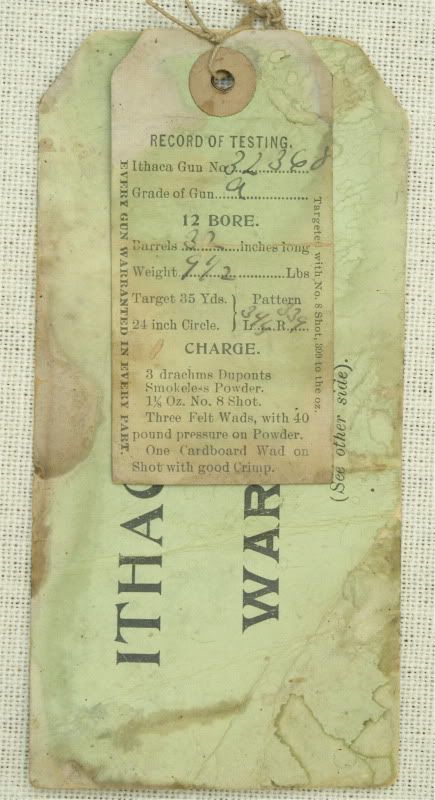 Some may find the reverse of the little tag of interest. Over 100 years old but still valid IMHO. 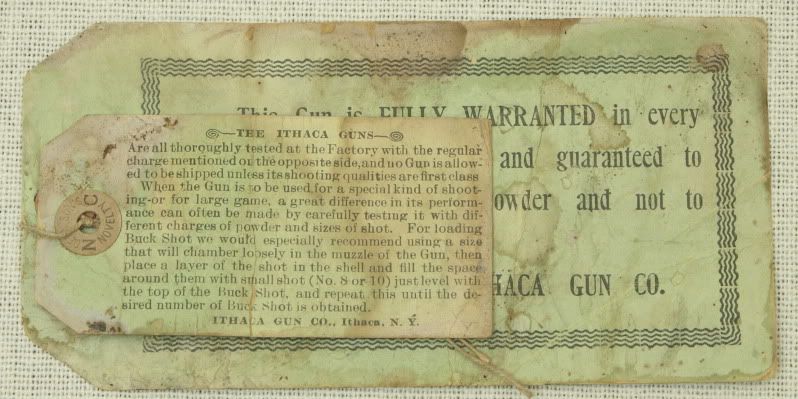
Last edited by Walter C. Snyder; 09/21/11 09:38 PM.
Walter c. Snyder
|
|
|
|
|

