|
S |
M |
T |
W |
T |
F |
S |
|
|
|
|
1
|
2
|
3
|
4
|
|
5
|
6
|
7
|
8
|
9
|
10
|
11
|
|
12
|
13
|
14
|
15
|
16
|
17
|
18
|
|
19
|
20
|
21
|
22
|
23
|
24
|
25
|
|
26
|
27
|
28
|
29
|
30
|
|
|
|
|
Forums10
Topics39,964
Posts568,889
Members14,649
| |
Most Online19,682
Mar 28th, 2026
|
|
|
|
Joined: Jan 2002
Posts: 568
Sidelock
|
OP

Sidelock
Joined: Jan 2002
Posts: 568 |
I know Turnbull and Color Case company do quality work, who else does bone/charcoal color hardening? I think I remember a Dr. Hambridge or something like that and I know others.I have a friend who is contemplating having a gun done. The last time I had one done, Dr. Gaddy did the work, so I am kind of out of the loop.
Thanks,
Chris
|
|
|
|
|
Joined: Aug 2005
Posts: 1,698
Sidelock
|
|
Sidelock
Joined: Aug 2005
Posts: 1,698 |
Hi Mr. Chris --- Color case co. is no longer open as owner is in poor health. John Gillette of (Classic Guns Inc.) has been at it for close to 40years & studied with Dr. Gaddy. Dr. Bill H. is retire due to health problems too, bad neck injury. Give me a call & I'll give you more info regarding who I use & other helpful info.
Ken Hurst
910-221-5288
|
|
|
|
|
Joined: Jan 2002
Posts: 299
Sidelock
|
|
Sidelock
Joined: Jan 2002
Posts: 299 |
Hi I am using Classic Gun Inc. to do my case color work. I have sent him several Remington's, and the colors looked just like the original color's on my Remington model 1894 and model 1900 doubles. Terry Deem
|
|
|
|
|
Joined: Mar 2002
Posts: 1,815 Likes: 4
Sidelock
|
|
Sidelock
Joined: Mar 2002
Posts: 1,815 Likes: 4 |
Another Yes to Ken Hurst's comment. Classic Guns does a great job and very knowledgeable. http://www.classicgunsinc.com/
|
|
|
|
|
Joined: Dec 2006
Posts: 3,361 Likes: 440
Sidelock
|
|
Sidelock
Joined: Dec 2006
Posts: 3,361 Likes: 440 |
Gregory J. Westberg
MSG, USA
Ret
|
|
|
|
|
Joined: Jan 2002
Posts: 10,361 Likes: 159
Sidelock
|
|
Sidelock
Joined: Jan 2002
Posts: 10,361 Likes: 159 |
gjw: keep that pot sturrin...de rats is shuflin...ed1
Last edited by ed good; 01/13/09 03:39 PM.
keep it simple and keep it safe...
|
|
|
|
|
Joined: Jan 2002
Posts: 10,361 Likes: 159
Sidelock
|
|
Sidelock
Joined: Jan 2002
Posts: 10,361 Likes: 159 |
quality case coloring should provide cosmetic enhancement without endangering gun integrity or shooter safety....be careful if you are contemplating sending your prized shotguns receiver to a high heat bone charcoal guy. he is going heat it up to around 1600 degrees F... make sure that you get it in writing, that if the receiver warps in the heating and tempering process or that if it cracks after firing, then the case colorer will assume full financial responsibility for the destruction of your gun and/or your personal injury. ed1
Last edited by ed good; 01/13/09 05:45 PM.
keep it simple and keep it safe...
|
|
|
|
|
Joined: Dec 2008
Posts: 2,292
Sidelock
|
|
Sidelock
Joined: Dec 2008
Posts: 2,292 |
[img]  [/img]   Chris: Any of the better shops who offer true bone and charcoal color casing....these are my three LC's I did myself...12-16-20...I do just my own stuff.......I don't spray the clear lacquer on them, for my taste, I like the natural state better.... The aforementioned Classic Guns are very good, and Mike Hunter put a post up showing his stuff, which looks very good as well.. Best Regards,
Doug
|
|
|
|
|
Joined: Jan 2002
Posts: 518
Sidelock
|
|
Sidelock
Joined: Jan 2002
Posts: 518 |
John Gillette of Classic Guns, Inc. case-colored my Sporting Clays Classic Parker Repro. He also arranged to have the engraving recut after he polished the metal. Although Gillette's resulting typical colors are not exactly Parker-like, they are, nonetheless; stunning and beautiful. After the metal was re-colored, Gillette applied Galazan's case-color lacquer, which brightens the colors a bit: 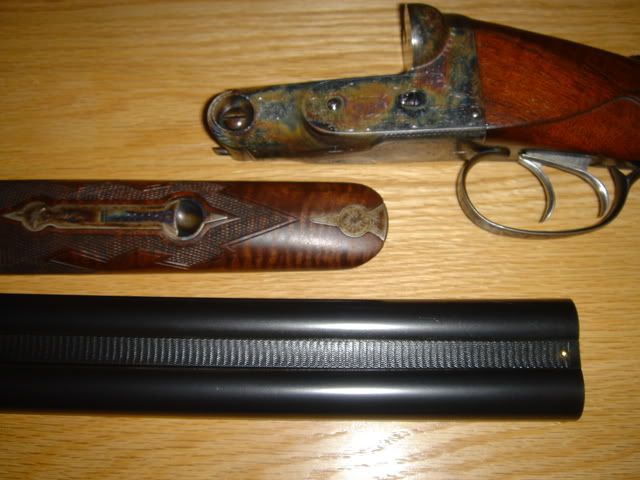
|
|
|
|
|
Joined: Jan 2002
Posts: 5,205 Likes: 79
Sidelock
|
|
Sidelock
Joined: Jan 2002
Posts: 5,205 Likes: 79 |
Didn't I hear of a shop in CT that was doing good work also? Anyone remember?
My problem lies in reconciling my gross habits with my net income.
- Errol Flynn
|
|
|
|
|
Joined: Jan 2004
Posts: 7,733 Likes: 697
Sidelock
|
|
Sidelock
Joined: Jan 2004
Posts: 7,733 Likes: 697 |
PA24, that is really nice work! Really nice!
Another place doing case coloring is Wyoming Armory in Cody, WY. The WA is comprised of a bunch of folks that did not go with Ballard Rifles to Michigan. I believe Keith Kilbey is their case color expert.
Brent
_________ BrentD, (Professor - just for Stan) =>/ ![[Linked Image from i.imgur.com]](https://i.imgur.com/qclHjMQ.jpg)
|
|
|
|
|
Joined: Jun 2008
Posts: 87 Likes: 12
Sidelock
|
|
Sidelock
Joined: Jun 2008
Posts: 87 Likes: 12 |
The shop in CT that I was pleased with was Clark Gunsmithing And Restorations, LLC of 221 East Haddam Colchester Tpke, East Haddam, CT 06423, tel. 860-873-9639. In 2008, they did the top two Ithaca NIDs. The bottom 410 has likely the original case color. 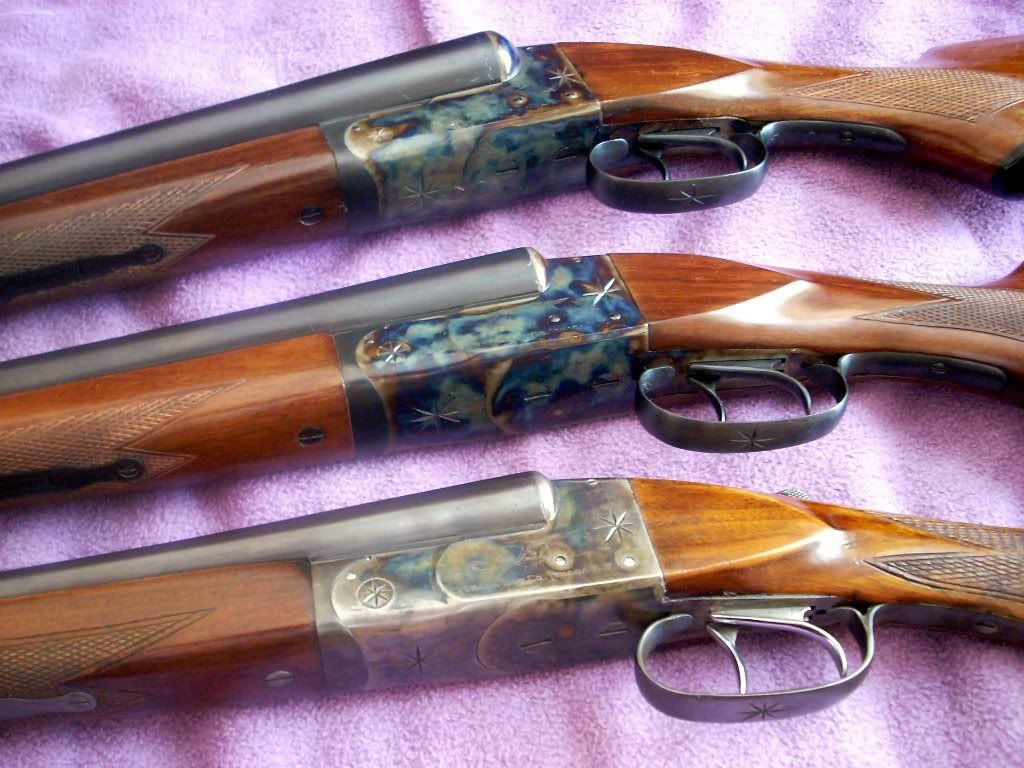
|
|
|
|
|
Joined: Dec 2008
Posts: 2,292
Sidelock
|
|
Sidelock
Joined: Dec 2008
Posts: 2,292 |
Thank you Brent.....
I try to stay away from the "orangie" look and keep it as original as possible......labor of love I guess..??????
Best Regards,
Doug
|
|
|
|
|
Joined: Aug 2005
Posts: 1,698
Sidelock
|
|
Sidelock
Joined: Aug 2005
Posts: 1,698 |
Chris, Years ago I started asking pertinate questions of those doing CCH for my clients. They in general all said they kept their furnaces at 1300 to 1250 degrees. My source of CCH uses 1300 degrees for his color hardening. I send approx. 50-60 guns a year to him for this service , being doing so for the past 8 years --- no problems with metal moving, cracked frames or any unhappy clients. That's lots of guns with no problems. FWIW
Ken Hurst
910-221-5288
|
|
|
|
|
Joined: Jan 2003
Posts: 1,227
Sidelock
|
|
Sidelock
Joined: Jan 2003
Posts: 1,227 |
Ken's experience is not to be taken lightly. When I go to file and prep my own action, I'll follow his lead, If you disassemble and do your own polishing, most shops will do do the CCH for <$300. Some won't have it any other way. When you find one that will receive your entire gun as is and return it with new CCH, you'll likely be paying many hundreds. My last one was done a year ago (disassembled, polished, CCH'd, reassembled) by Giacomo Sporting in Lee Center, NY for <$400.  
|
|
|
|
|
Joined: Feb 2004
Posts: 132
Sidelock
|
|
Sidelock
Joined: Feb 2004
Posts: 132 |
I teach a manufacturing process class at the University of North Dakota and I have all of my students (28 this semester) do bone and charcoal color casehardening on the baseplates for the steam engines we build. I've found during my own experiments (and that of students) that it is quite easy to get decent colors; however, we don't do gunwork at the university. Our recipe is 50/50 mix of wood to bone charcoal (purchased at Brownells) and a soak at 1350-1400 degrees for two hours in an electric furnace. I use an old 55 gallon drum for a quench tank that has been rigged up with a thermometer, airline, and a drain. We have a sheet steel lid with a hole cut out of the center. The quench process involves sliding the crucible over the hole and the air exposure is almost nil, which seems to improve the odds of getting good colors significantly. I've got really good colors at temps lower than 1300 degrees, in some cases better than I get at the higher ranges, just not as hard a surface. We always draw our parts in a 400 degree oven for 1-2 hours following the quench which I think improves the color somewhat, but it also would be a good way of preventing some sections from being to brittle.
My experiences have been the higher 1600+ temperatures don't yield great colors, Dr. Gaddy suggested many of the original makers probably stayed in the lower temp ranges. The poster that commented that this process is unsafe for firearms receivers is contradicted by millions of existing shotguns that were subjected to the same process. I'm not in the business of doing this process except in an educational sense and the only reason that I mention it is that if students with little or no prior experience can pull this process off, so can you. All it takes is a bit of equipment and a lot of experimentation, plus, it is a great deal of fun.
Last edited by Alex Johnson; 01/13/09 10:25 PM.
|
|
|
|
|
Joined: Jan 2002
Posts: 568
Sidelock
|
|
OP
Sidelock
Joined: Jan 2002
Posts: 568 |
PA24 - Great job!
Ken - I'll give you a call.
Thanks to all for the responces, I will pass them all along.
Alex - I just wish I had the time to do all this, the students in your class are lucky to learn this and understand the process.
Chris
|
|
|
|
|
Joined: Aug 2005
Posts: 1,698
Sidelock
|
|
Sidelock
Joined: Aug 2005
Posts: 1,698 |
WOW, what a world of info on this bbs, thanks Alex. I certainly would like to talk to you sometime & down load your brain.
PA24 --- great looking job's. I'm amazed at all those here that do such beautiful work.
Chris, John Gillette at "Classic Guns Inc." charges $200. for a striped,polished Sterly. I look for to speaking with you.
Ken Hurst
910-221-5288
|
|
|
|
|
Joined: Feb 2004
Posts: 132
Sidelock
|
|
Sidelock
Joined: Feb 2004
Posts: 132 |
Ken, my brain is filled with the stuff I read here from people like you and other great sources, I doubt I have anything as original or as creative as the work you do to offer the world. If anybody wants to see it, here is a small video we shot of our process awhile back. In this clip we are using a smaller furnace (the bigger one is right behind it visible in the corner) and we are using only a 5 gallon bucket for a quench tank with no airline which is a setup we used to use frequently for small parts with good results. You can also see our "high tech" toaster oven in the background that we use to draw the parts once their out of the quench. We have more sophisticated furnaces, but the toaster oven works and it is cheap. Anyway, here's the link. http://smg.photobucket.com/albums/v733/44-henry/?action=view¤t=ColorCaseVideo.flv
Last edited by Alex Johnson; 01/13/09 11:38 PM.
|
|
|
|
|
Joined: Feb 2007
Posts: 384
Sidelock
|
|
Sidelock
Joined: Feb 2007
Posts: 384 |
If you ask Holland or Purdey they get their case hardening done by St Ledger in Birmingham, England. Friends in the trade tell me there are only two others who are in his league or equal, Doug Turnbull in the USA and Schilling in Austria, best, Mike Bailey
|
|
|
|
|
Joined: Dec 2008
Posts: 277 Likes: 6
Sidelock
|
|
Sidelock
Joined: Dec 2008
Posts: 277 Likes: 6 |
Think it would be good to have a Gunsmithing Forum on this site; lots of serious talent here.
Alex, PA24 and others have given some very good advice on keeping the temps low.
As an example of this: recently got a Winchester 1886 in; customer called me saying that he had it CCH by another company, and his gunsmith had broken the buttplate trying to assemble the gun.
He asked that I weld up & CCH the BP, and assemble his 86. Gun came in and I could tell immediately that the CCH parts were quenched at too high a temperature (Colors were way too dark). Then when trying to assemble the gun, found that the frame was warped enough that the bolt would not fit in the frame, hammer wouldn’t fit in the lower tang (that bad).
Called the customer up, gave him the bad news, and told him that the frame was repairable but; I wasn’t about to fix the frame without annealing it first.
So annealed the frame, about 5 hours straightening the frame and then re CCH. That inexpensive CCH job cost him some serious $$$.
In my guesstimation here is what the first …Expletive.. did wrong:
Did not anneal frame before CCH
To hot & too long soak at hardening temp
Did not properly block the parts
Quenched at too high a temperature.
Quenched in a weak Brine solution (which cools much faster that straight water)
FYI: For those of you that may not know, Ebonex is the only manufacturer of Bone Charcoal in the country… So no matter who supplies the Bone Charcoal ie.. Brownells, Midway etc. Ebonex manufactured it. You can call them directly and order straight, generally at a better price if you buy in quantity & open an account. Might be good for commercial & institutional consumers.
|
|
|
|
|
Joined: Aug 2004
Posts: 877 Likes: 137
Sidelock
|
|
Sidelock
Joined: Aug 2004
Posts: 877 Likes: 137 |
I just got a 50 lb bag in from them today @ $2.10 p/lb,...has almost doubled in price since my last order
CJ
The taste of poor quality lingers long after the cheap price is forgotten.........
|
|
|
|
|
Joined: Aug 2005
Posts: 1,698
Sidelock
|
|
Sidelock
Joined: Aug 2005
Posts: 1,698 |
Iam in total agreement with you Mr. Mike ! In case our gracious host Mr. Dave reads this, a gunsmithing forum would certainly benefit all the readers of the other forums. Most all of us have a need from time to time for some sort of smithing advice or contacts. Well, I feel this type of forum would certainly attract the attention of our current membership as well as show the growth of this bbs to others & attract new members & sponcers. FWIW
Last edited by Ken Hurst; 01/14/09 04:03 PM.
Ken Hurst
910-221-5288
|
|
|
|
|
Joined: Jan 2002
Posts: 5,954 Likes: 15
Sidelock
|
|
Sidelock
Joined: Jan 2002
Posts: 5,954 Likes: 15 |
MH - excellent discussion. Thanks.
Sticking with your example above, is the frame mild steel or does it have enough carbon to do some through hardening? When you anneal the frame, are you actually annealing only the case "skin," or do you actually soften the frame some? Do you have a process more compicated than passing the frame through critical temperature and then cooling slowly? In theory, it would seem that the "skin" would anneal as soon as it reaches critical and that the pre-annealing would not be necessary; any ideas as to why the first annealing step is necessary? Since the frame already has a case "skin" of high carbon steel from the factory case process, why do you soak it again? Does warpage come from unequal "skin" stress early in the heat or from unequal "skin" stress coming out of heat, like in quench? Or, does it come from within the base metal? Thanks, if you care to answer these.
Last edited by Rocketman; 01/14/09 04:43 PM.
|
|
|
|
|
Joined: Dec 2008
Posts: 277 Likes: 6
Sidelock
|
|
Sidelock
Joined: Dec 2008
Posts: 277 Likes: 6 |
Rocketman
Geesh; hard Questions… Hope you bear with me while I try and answer this off the top of my head w/o aid of my metrology and heat treating books.
These old frames were made out of low carbon steel, what we would call SAE 1018 – 1020 today, 0.1 -0.2 % Carbon. Steels with less than 0.25% carbon are generally classified as mild or non hardening steel.
Medium Carbon Steels have 0.25% - 0.5% carbon (SAE 4140)
High Carbon Steels 0.5% and higher carbon content, (SAE 1095)
Generally the last two digits of steel’s SAE number will tell the carbon content.
Case hardening is used on mild steels.
Thru hardening process is used on medium and high carbon steels.
Hardening occurs during heat treating when the steel (containing sufficient carbon) is cooled rapidly (quenched) from above its critical temperature. Mild steel heated and quenched from above its critical temperature will show no increase in hardness. In order to harden mild steel, its carbon content must be increased. To do this, the steel is placed in a carbon rich environment (Bone & Wood Charcoal) at a high temperature (above critical point). As bone & wood charcoal (almost pure carbon) is heated; it starts to produce Carbon Monoxide and a small amount of Carbon Dioxide gas, which is readily absorbed by the steel at higher temps. The longer the steel is held in this environment the deeper the penetration of carbon or “Case”.
When I anneal a frame, I generally heat it above its critical temp in a low oxygen environment (prevent scaling) and let it cool gradually, generally 12-14 hours. Annealing will remove the hard outer (case) hardening, and normalize the steel, relieving internal stresses, the frame in total is normalized.
Your Question : “it would seem that the "skin" would anneal as soon as it reaches critical” is interesting, and yes I wondered that myself, “wouldn’t the steel self anneal when heated above critical temps”. The simple answer is no. Annealing takes time and slow cooling, think of an ice cube melting at 36 degrees, it will melt but it takes time. Also since the bone/wood mixture starts producing Carbon Monoxide far below the steel's critical temp, and the steel will start to absorb this carbon below its critical temp, you are actually adding to the carbon already in the outer layer.
Does warpage come from unequal "skin" stress early in the heat or from unequal "skin" stress coming out of heat, like in quench? Or, does it come from within the base metal? Yes.. The majority of warpage comes from uneven cooling of the metal during quench, the more mass (thicker the material), obviously the more retained heat and the longer it takes to cool, this can be from milliseconds to seconds. I’m always concerned with thin areas attached to a larger mass. The temperature of quench and the ability of the quench to absorb/transfer heat away from the part have a significant impact. Quenching parts in boiling water will greatly reduce the shock of quenching, but will also reduce the amount and depth of hardening. Another example: SAE 1095 is an oil quench steel. Oil’s reduced ability to transfer and absorb heat buffers the shock of quenching this high carbon steel. If 1095 were quenched in water (greater heat transfer) you would have significant issue with warpage, cracking and uneven hardening.
So did I pass?
|
|
|
|
|
Joined: Dec 2008
Posts: 2,292
Sidelock
|
|
Sidelock
Joined: Dec 2008
Posts: 2,292 |
Mike, you get an A+ on my report card...
You may want to explain to them how NOT blocking-supporting parts (large open areas, which heat and cool at different speeds and temps) will cause them to warp as well....i.e., the rifle receiver you mentioned was probably cased without the bolt or a dummy bolt in place.......and possibly without the trigger block in place ?
The warping is minute, but nonetheless it must be fixed....this CAN ALL BE AVOIDED IF DONE PROPERLY...AS MENTIONED ABOVE....
Most gun metals and tool steels case to a depth of about .005..not much more.....
The greatest harm to any case color is U.V. light...leave your gun in the sun for long periods, or in a glass doored gun cabinet, exposed to sunlight and the case colors will rapidly go bye-bye.......that's why the old guns just have the "mottled" look, still very hard...but the colors are gone.....and there are some you will see at the shows 100+ years old that look like new...they have been "kept in the dark"..!!!!
I use dummy screws etc. to secure actions etc., in the crucible...as I am sure you do as well.....
Best Regards,
Doug
|
|
|
|
|
Joined: Jan 2002
Posts: 7,726 Likes: 129
Sidelock
|
|
Sidelock
Joined: Jan 2002
Posts: 7,726 Likes: 129 |
The greatest harm to any case color is U.V. light...leave your gun in the sun for long periods, or in a glass doored gun cabinet, exposed to sunlight and the case colors will rapidly go bye-bye.......that's why the old guns just have the "mottled" look, still very hard...but the colors are gone... I don't know anything about metalurgy or heat treating either one, and about all I know about doubleguns, I learned here from listening to our experts. So, not to dispute the quote above, but I thought that Dr. Gaddy had always advised that UV would NOT harm or fade case colors, and that only wear would remove them. Did I have that wrong???...Geo
|
|
|
|
|
Joined: Aug 2005
Posts: 1,698
Sidelock
|
|
Sidelock
Joined: Aug 2005
Posts: 1,698 |
George, in a private showroom at the Colt factory the lighting was flouresent & was left on 24 hours a day. About once a year + the SAA were removed due to fading on the display side to be redone. I agree, UV seems to wash out colors. In fairness, I have heard others say the same as the good Dr. Also, I have left a coupon that is CCH in my shop window for the past three years that hasn't faded one bit. I donno, looks like a toss up. FWIW
Ken Hurst
910-221-5288
|
|
|
|
|
Joined: Dec 2008
Posts: 2,292
Sidelock
|
|
Sidelock
Joined: Dec 2008
Posts: 2,292 |
Hi George:
I've run some tests over the years.....casing two identical pieces of steel....put one out in the sun...leave one in a drawer.....ultimately, the one outside will lose it's color quite fast....like 6 mos....the one in the drawer will stay brilliant..?? Of course, that was the Arizona-Utah sun, which is the real deal as far as sun goes.............when I say lose, I mean a fade, not complete loss.....obviously the longer you leave it out, the more it fades....
That has been my experience...so I would have to stand by it ...other fellows have confirmed this as well...
Best Regards,
Doug
|
|
|
|
|
Joined: Jan 2002
Posts: 7,726 Likes: 129
Sidelock
|
|
Sidelock
Joined: Jan 2002
Posts: 7,726 Likes: 129 |
Thanks for the additional information...as Muderlak would say "Investigation continues"...Geo
|
|
|
|
|
Joined: Jan 2002
Posts: 568
Sidelock
|
|
OP
Sidelock
Joined: Jan 2002
Posts: 568 |
Boy, this has been some great information, much more than I expected! Thanks to all of you.
Chris
|
|
|
|
|
Joined: Nov 2005
Posts: 4,598
Sidelock
|
|
Sidelock
Joined: Nov 2005
Posts: 4,598 |
George, in a private showroom at the Colt factory the lighting was fluorescent & was left on 24 hours a day. About once a year + the SAA were removed due to fading on the display side to be redone. I agree, UV seems to wash out colors. In fairness, I have heard others say the same as the good Dr. Also, I have left a coupon that is CCH in my shop window for the past three years that hasn't faded one bit. I donno, looks like a toss up. FWIW Ken, This is very true about fluorescent lights. For alternative photographic prints, eg Platinum, Cyanotype, etc a light box is constructed of fluorescent tubes because of the potential for high UV output. Even the new compact fluorescents put out some amount of UV. It is easier to gain control than using the sun. The only alternative is to choose tubes with very low UV output and use UV resistant glass in the cabinets. Pete
|
|
|
|
|
Joined: Jan 2002
Posts: 5,954 Likes: 15
Sidelock
|
|
Sidelock
Joined: Jan 2002
Posts: 5,954 Likes: 15 |
MH - A+ from me. However, I don't like it when theory and practice don't jive; don't like it at all. I'm not disparaging your practice, not suggesting you change it. I'm just going to keep looking for some harmonization with theory. I'd appreciate any additional thoughts you , or anyone else, has on the subject of annealing an action prior to recasing it.
I fully understand the need and practice of blocking. That really makes sense.
As for light induced fading of CC, I spoke at length on this subject with Dr. O. G. He and I agree that there is no theory as to why CC would be photosensitive. I wonder why there is data on both sides of this argument?? We must be missing some factor. Is it possible that differing surface protectants are in use and they are differing in photoreactivity? Has anyone ever looked at a CC surface under high magnification before and after a UV exposure test? Comments welcome.
Thanks for the discussion!!
|
|
|
|
|
Joined: Dec 2008
Posts: 277 Likes: 6
Sidelock
|
|
Sidelock
Joined: Dec 2008
Posts: 277 Likes: 6 |
Rocketman
I’m not sure I understand the discrepancy between theory and practice.
Annealing is not a bad thing; most steels are annealed post machining to reduce internal stress. Many metals will work harden during the manufacturing process. W-1 in my mind is particularly bad, it will self harden while machining. You need to get rid of these internal stresses and uneven hardening.
Annealing does a beautiful job of that.
I find I get better welds once case hardened steels are annealed, less porosity. I will always anneal a part after welding, gets rid of those hard spots caused by welding.
I’m sure Mr. Ken Hurst will back me up on this, engravers hate working on welded areas that haven’t been annealed, one of those hard spots can easily break a graver tip, hitting a hard spot is never a pleasant surprise for an engraver.
Annealing can salvage a frame that has been overheated in a fire, as long as the steel has not been burnt can generally be annealed and saved.
In the case of the 1886 that I noted earlier, the depth of case was too deep, fairly evident when the butt plate snapped when the gunsmith installed it.
There was no way I was going to straighten that frame while hardened, chances of me cracking it were too high. Annealing softened the frame, made it more flexible/malleable and easier to work without the fear of breakage.
So if you don’t mind, would you please expound on the discrepancies between theory and practice, esp. mine.
Thanks
Mike
|
|
|
|
|
Joined: Aug 2006
Posts: 266
Sidelock
|
|
Sidelock
Joined: Aug 2006
Posts: 266 |
PA-2
You stated that you try to stay from the orange colors. How do you accomplish that?
|
|
|
|
|
Joined: Dec 2008
Posts: 2,292
Sidelock
|
|
Sidelock
Joined: Dec 2008
Posts: 2,292 |
LD1:
After 40 years of case coloring and lots of trial and error, there are a few things that are proprietary.....that is one of them.
Most of the cc guys have their own formula's and compositions, as do I.....and they will not relinquish same.....many processes/formula's are available on the net if you are interested in starting up your own cc set up. Many scientific papers are also available if you are slanted towards knowledge only..?
Best Regards,
Doug
|
|
|
|
|
Joined: Aug 2006
Posts: 266
Sidelock
|
|
Sidelock
Joined: Aug 2006
Posts: 266 |
PA24
Thanks for your reply. I fully understand your wanting to protect all of your work. I tried color case hardening one time at the research center about 30 years ago. The colors came out great, but I was never able to continue. They had some dumb rule about bringing any guns or parts on the premesis. Even when I helped Don Menk at Color case Company about 20 years ago he was somewhat secretive. I had not heard that Don is ill. He is a first class gentleman. One other question. I have seen some 98 Mauser actions color hardened at some of the gun shows. I was told by a gunsmith that they should in no way be color hardened due to the fact that one part of the action is kept at a different hardness than the other. Is that true?
Last edited by LD1; 01/17/09 10:46 AM.
|
|
|
|
|
Joined: Jan 2002
Posts: 176 Likes: 3
Sidelock
|
|
Sidelock
Joined: Jan 2002
Posts: 176 Likes: 3 |
Jim StLedger does case coloured 98s and they look great and he said it is all in knowing how to do it. If you do it wrong the action will fail! I have a few pictures that I can not find of his shop on Price St. form many years ago.
Cheers,
Laurie
falling block
|
|
|
|
|
Joined: Dec 2008
Posts: 2,292
Sidelock
|
|
Sidelock
Joined: Dec 2008
Posts: 2,292 |
LD1:
I have never cased a '98 Mauser action......I rebuilt a bring-back as a young boy, but hot blued the receiver....the action steel was very, very hard, and turned a beautiful deep wine red...I remember polishing that action, the metal was so hard that it came out like "glass" with jeweler's rouge on the wheel, without "any" wheel marks.....other smiths have told me that the good Mauser's are so hard that they will commonly break diamond drill bits when drilling and tapping for scope mounts...... Since they were not originally "color" cased and are already extremely hard, I see no need to re-case an already fine hard receiver that had no color in the first place..?? ...I would guess the Germans hot oil cased those receivers, but I don't know, a Mauser collector would know ?? ........They 'are' the action that all others are judged by......and the most copied of course...
Best Regards,
Doug
|
|
|
|
|
Joined: Jan 2002
Posts: 5,954 Likes: 15
Sidelock
|
|
Sidelock
Joined: Jan 2002
Posts: 5,954 Likes: 15 |
"So if you don’t mind, would you please expound on the discrepancies between theory and practice, esp. mine."
No issue on my side with your practice!! My issue is scientific curiosity. I don't doubt in any way that annealing is a good thing. What I don't understand is why a part would not anneal as it passes through critical temperature in the rehardening heat. I don't question that your practice produces fine results and that any part needing work would need annealing prior to that work and then rehardening. Maybe the point I'm missing is that all parts require something done before rehardening. Like, say, do you polish a reciever before or after annealing?
Lets take another example. Say we machine a part in W-2 such that it has significant internal stress. Then, we heat to through harden. Did the part lose the machining stresses as it was heated above critical?
|
|
|
|
|
Joined: Jun 2008
Posts: 87 Likes: 12
Sidelock
|
|
Sidelock
Joined: Jun 2008
Posts: 87 Likes: 12 |
(J.Kuhnhausen's Mausers shop manual) Case hardening of early mauser receivers as he tested ran approx .002"-.008". A hardness of .002-.005 is considered generally thin. M98's test equivalently to 1035 and 1036 steels. The 1035's generally gave rockwell C33-35 exterior hardness. FN's factory hardness test indentations were at the side of the recoil lug and on the flat bottom of the receiver behind the feed ramp.
Mauser98 case hardening thicknesses post-1936 vary but avg .008-.010" and up to .012-.018" were occassionally found. Ideal case thickness is .010-.015" w/ typical exteriors to a hardness of C35 to C40, and internal hardnesses of C22 to C30.
If a sharp awl or knife easily penetrates or scrapes the surface then the hardening should be considered too thin. Hardening is critical to prevent action lug area setback, w/ acceptable lug surface wear seating of up to .002". Interestingly, bolt lug C-scale readings run from 50-55 hardness generally, which provides a bolt tensile strength that can exceed 100,000 lbs.
His suggestions may shed light that receivers once hardened could be apparantly lightly buffed or lightly struck/etched with a 32percent HCL acid solution and then rust or oxide blued.
|
|
|
|
|
Joined: Apr 2008
Posts: 63
Sidelock
|
|
Sidelock
Joined: Apr 2008
Posts: 63 |
Rocketman,
I'll take a stab at answering this. This thread has been great. It got me thinking and researching. I got out my old college metallurgy book as well as did some research on the net to try and fully understand the phase transformation the steel is going through.
Here goes...anyone can chime in if I'm wrong.
Full annealing, which is what Mike is doing is accomplished by first raising the temp of the steel about 50 degrees above the A3 line (see carbon steel phase diagram). By doing this you are changing all the steel into austentite.
Once you get all the steel at the correct temp you slowly cool to get the steel to create very large grain pearlite. These terms are all engineering terms used to describe the types of phases of steel at different temperatures that can form based on its composition.
If you cool slow enough you get large grains of perlite. When you get this you get annealed steel, which is high ductile.
By just raising the temp and then quenching very quickly (as in case hardening) you never get to the pearlite phase of steel which requires very slowly cooling, so you never truly anneal the steel. Quenching create martensite.
The other key item to understanding why Mike needed to anneal the steel is related to carbon content in the surface of the steel. While researching I wanted to find information suggesting that during annealing the process allowed a majority of the excess carbon trapped in the case harden layer to diffuse out of the steel. I have not found the exact text that I want, but from what I have deduced annealing does allow diffusion of carbon so that you are reducing the % of carbon in the surface layer.
By re-case hardening without previously annealing you are trapping the original carbon from the first case hardening along with the additional carbon you are adding. This most likely pushes the carbon content in the surface too high and quenching quickly yields an overly brittle surface that is prone to cracking. My guess is that even some form of tempering will not help enough in eliminating the case hardened receiver from failing in the future.
In the end annealing basically sets the steel back to its baseline prior to doing any work in the form of hardening. By not putting the steel back to a baseline you are just adding to what someone has already done to it which pushes it past its yield point.
I'm not sure if that answers your question fully, but that is the best I can do with the research so far and my prior metallurgy knowledge which is 10 years old and limited.
If you spend a little time looking on Google for carbon steel, case hardeing, carburization, martensite, austentite and annealing, most of what I describe will be revealed by some website or another.
Hope this helps put theory to practical purpose.
Later,
Jason
|
|
|
|
|
Joined: Jan 2002
Posts: 5,954 Likes: 15
Sidelock
|
|
Sidelock
Joined: Jan 2002
Posts: 5,954 Likes: 15 |
First class piece of research, Jason. At this moment, I don't fully see the answer, but for sure it points the way to some research and review. I had assumed that the carbon in the case layer was more or less fixed. I guess, in theory, if we allowed it to heat soak long enough we would have a layer of cast iron rather that high carbon steel? Good things to think about!! Many thanks. I'll be back with some more questions. Hope you will continue some research and report.
|
|
|
|
|
Joined: Aug 2006
Posts: 266
Sidelock
|
|
Sidelock
Joined: Aug 2006
Posts: 266 |
Commenting on the original question of this post:
In the early 1970s a gentleman from across the pond named Brian Ebbs brought over a nice selection of British double rifles that were each totally restored to as new condition. Most were Alexander Henrys in .450 or .500 caliber. They were priced at $500.00 each. I was just out of college and didn't have the money to buy them then. Anyway, the point is that the color hardening on them was very similar to the work that Doug Turnbull
does. I believe that Brian's rifles were color hardened by St. Ledger. I would like to see a picture of one of those rifles if any member of this discussion group owns one. They were magnificent.
|
|
|
|
|