|
S |
M |
T |
W |
T |
F |
S |
|
|
1
|
2
|
3
|
4
|
5
|
6
|
|
7
|
8
|
9
|
10
|
11
|
12
|
13
|
|
14
|
15
|
16
|
17
|
18
|
19
|
20
|
|
21
|
22
|
23
|
24
|
25
|
26
|
27
|
|
28
|
29
|
30
|
|
|
|
|
|
|
1 members (welder),
1,484
guests, and
6
robots. |
|
Key:
Admin,
Global Mod,
Mod
|
|
|
Forums10
Topics40,177
Posts571,691
Members14,678
| |
Most Online32,084
Jun 14th, 2026
|
|
|
|
Joined: Jul 2008
Posts: 30
Boxlock
|
OP

Boxlock
Joined: Jul 2008
Posts: 30 |
Problem Statement : I purchased a B. Rizzini, 20 Ga., O/U shotgun - but, failed to definitively pattern the gun for barrel regulation before the warrenty expired. Now, after careful testing, it appears that the upper barrel's point of impact is approximately 16 inches higher than that for the lower barrel at 40 yards. The lower barrel's point of impact seems well aligned ("centered")at 40 yards with the "normal" site picture. This differential in the points of impact for the two barrels appears to be unacceptably large.
There appear to be two possible solutions.
1. Connecticut Shotgun (who represents Rizzini in the US) gratiously offered to provide new barrels at their cost plus the action/barrel fitting fee. But, I have no response to my inquiry concerning the specification for regulation of the new barrels which can be anticipated or guaranteed. Do other members of the forum have information / standards / specifications for point-of-impact barrel regulation which can be expected from "good" double guns? I understand that perfect superposition of the two patterns of a double gun is unrealistic - but, what is a reasonable expectaion for the differential in the points of impact for the barrels?
2. I contacted Briley manufacturing with respect to the manufacture of compensating, screw-in, chokes to correct the point of impact problem with the upper barrel. In this case the bore of the choke is angled with respect to the barrel bore to compensate for the barrel's misalignment. Briley seems confident in achieving a good technical solution to the problem. In my opinion the required compensating angle may "push" the physically possible, choke geometry, modifications.
Do other members of the forum have experience with this type of compensating choke modification? Are the patterns created by these compensating chokes as good as those produced with standard, uncompensated, chokes?
Thanks for your help with these questions.
Don Henderson
Don Henderson
|
|
|
|
|
Joined: Feb 2004
Posts: 13,883 Likes: 21
Sidelock
|
|
Sidelock
Joined: Feb 2004
Posts: 13,883 Likes: 21 |
Don,
It sounds like the gun isn't fit well to you to get that top barrel to shoot for you. Try having someone you trust as a good gunner but of different body shape than you give the pattern testing a try.
While you may have a gun with bad POI match barrels, the gun should shoot the top barrel at your point of aim. That gun either doesn't fit you well or the top barrel has a problem.
|
|
|
|
|
Joined: Jan 2003
Posts: 1,227
Sidelock
|
|
Sidelock
Joined: Jan 2003
Posts: 1,227 |
I have a friend who had the same issue with his Rizzini clays gun. He struggled with it for a least a year before arriving at a diagnosis. This spring he had it "Eysterized." After his session at Eysters he's turned into a patterning maniac. He also quickly made master class now that his gun shoots straight and he's been tearing up the tournament circuit. In fact, he just kicked our butts and took HOA again yesterday. 
|
|
|
|
|
Joined: Nov 2007
Posts: 5
Boxlock
|
|
Boxlock
Joined: Nov 2007
Posts: 5 |
Chuck,
I was with Don when he did some of the testing for barrel regulation on his Rizzini O/U 20 gauge. I don't believe gun fit has anything to do w/ the the barrel regulation. The same sight picture was used w/ each shot. Points of impact being high/low, right/left, for both barrels would be indicative of Poor gun fit, but not one barrel relative to the other given the same sight picture is used for firing both barrels.
|
|
|
|
|
Joined: Jul 2008
Posts: 30
Boxlock
|
|
OP
Boxlock
Joined: Jul 2008
Posts: 30 |
Chuck --
I understand your argument with respect to the point of impact for the upper barrel vs. the lower barrel. But, in point of fact the upper barrel does shoot high. Roger (see Roger's reply) and I undertook extensive testing. We considered barrel heating. We exchanged chokes between barrels. We both shot the gun. All these experiments lead to the same conclusion. There is a substantial divergence in the point of impact for the barrels.
Best Regards,
Don
Don Henderson
|
|
|
|
|
Joined: Jul 2008
Posts: 30
Boxlock
|
|
OP
Boxlock
Joined: Jul 2008
Posts: 30 |
Mike --
Thanks.
I found your reply very interesting --- particularly since I do not recognize the term "Eysterized". To what does this term refer? Is this a choke manufacturer?
Best Regards,
Don
Don Henderson
|
|
|
|
|
Joined: Feb 2004
Posts: 13,883 Likes: 21
Sidelock
|
|
Sidelock
Joined: Feb 2004
Posts: 13,883 Likes: 21 |
No arguement Don. It sounds like you identified the problem.
I think Mike is referring to Ken Eyster.
Ken Eyster Gunsmiths Inc
6441 Bishop Rd
Centerburg, OH 43011
Last edited by Chuck H; 07/13/08 06:40 PM.
|
|
|
|
|
Joined: Jul 2008
Posts: 30
Boxlock
|
|
OP
Boxlock
Joined: Jul 2008
Posts: 30 |
Thanks, Chuck.
Indeed, I did find a reference to Ken Eyster in a Google search.
I may try contacting Eyster to discuss the problem.
Best Regards,
Don
Don Henderson
|
|
|
|
|
Joined: Jan 2003
Posts: 1,227
Sidelock
|
|
Sidelock
Joined: Jan 2003
Posts: 1,227 |
Don,
Chuck is right. There are 3 reknown shotgun barrel men that come to mind. I'm not really intimate with their services, but the impression I have is that Stan Baker was a guru of overboring (a lot of skeet guns?), Ken Eyster barrel regulation via choke alteration, and Tom Wilkinson overboring and choking trap guns. I imagine any of them could do it all, that's just what I remember. I had Tom backbore some barrels and the workmanship was superb. These guys are also of the old school of tuning a choke to deliver X% at a certain yardage, et. with a particular load. You might want to just do a search on those names on trapshooters.com for some interesting reading.
Briley Corp has a good rep, but I find it to be a bit large and impersonal for my tastes. I know of too many cases where the "paint job was fantastic, but the wrong color was used."
|
|
|
|
|
Joined: Jul 2008
Posts: 30
Boxlock
|
|
OP
Boxlock
Joined: Jul 2008
Posts: 30 |
Mike --
Thanks for the additional information. I very much appreciate your help. I knew of Stan Baker -- but, not the others.
I will see where all this information leads.
As a point of discussion, Without the rejoining of the barrels, I cannot see how the barrel performance can be usefully altered, except by choke modification. So, this may narrow the field in light of your descriptions of the competencies.
I agree, Briley does seem to have grown enormously, since I first dealt with them. On the other hand I have never experienced a single problem in any of my interactions. I have carefully measured the Briley choke dimensions and surface finishes. I have been very much impressesed with their machining capabilities and quality control. Briley is prepared to pattern the gun ($125) to define the requirements for the choke alterations .... or I can supply representative patterns / information.
Thanks again.
Best Regards,
Don
Don Henderson
|
|
|
|
|
Joined: Jul 2005
Posts: 7,065 Likes: 1
Sidelock
|
|
Sidelock
Joined: Jul 2005
Posts: 7,065 Likes: 1 |
Don in response to your question about acceptable "Point of Aim versus Point of Impact" I have done some research and found very few definitive answers. I have a Beretta SO5 which is a hand made over and under. At 40 yards the bottom barrel shoots 4" lower and 6" to the left. I used a pattern analysis program called "Shotgun Insight" to analyze the data. This bore out over several different cartridges and chokes. The patterns were shot freehand. Over on 16gauge.com the resident BBS know-it-all stated he got a figure from Browning of no more than 4" difference in point of impact between the two barrels. He quotes Stan Baker all the time and says Stan helped him get satisfaction from Browning.
Best,
Mike
Last edited by AmarilloMike; 07/13/08 08:34 PM.
I am glad to be here.
|
|
|
|
|
Joined: Feb 2004
Posts: 13,883 Likes: 21
Sidelock
|
|
Sidelock
Joined: Feb 2004
Posts: 13,883 Likes: 21 |
Don,
Have you identified if the barrel bore of the top barrel is off or if it was just a misaligned machined screw choke bore and thread? 16" @ 40 yds should be discernable by blocking up the barrels and sighting the bores vs. the other barrel and the sight picture.
|
|
|
|
|
Joined: Jul 2008
Posts: 30
Boxlock
|
|
OP
Boxlock
Joined: Jul 2008
Posts: 30 |
Mike --
Thanks for the information, re: your SO5, Browning and Baker. This "4 inch, maximum differential," metric seems consistent with some information I remember reading, years ago. (I cannot remember where.) Its seems that this was considered a reasonable manufacturing tolerance for double guns. But, if you do the arithmetic, assuming straight barrels, this 4 inch point of impact tolerance implies an 0.078 inch difference in spacing of the bore axes - front to back - along the length of 28 inch long barrels. That is a very large value for a manufacturing tolerance for this dimension. Perhaps the assumption of straight barrels is a poor one. Additionally, there is the question of the axial accuracy of threading of the barrels for the chokes. It all adds up. Interesting -- if disconcerting.
Best Regards,
Don
Don Henderson
|
|
|
|
|
Joined: Jul 2008
Posts: 30
Boxlock
|
|
OP
Boxlock
Joined: Jul 2008
Posts: 30 |
Chuck --
I believe your point about fixing the barrels in position and sighting through the barrels at a distant mark to assess the alignment of the barrels is correct and a good suggestion. A mark centered in the view presented in one barrel should also appear centered in the other barrel -- with correct / parallel barrel alignment. But, as you probably know, one must have the eye precisely located along the axes of the bores in making this evaluation. When aligned with the axis of a straight barrel the eye sees a set of concentric rings. Concentric rings will not be found, if the barrel is not straight. Some ring distortions will be found in this case.
I undertook this procedure, when I purchased the gun and the result looked reasonably good. I could not ascertain any significant difficulties / misalignment. Even the ring concentricity appeared reasonably good.
As impied in your note, all together -- these findings may indicate that the threading for the chokes is at fault. But, the choke threading appears to be centered in the bore of the barrels at the muzzle. The wall thickness appears to be uniform around each barrels periphery. But, I can more carefully measure these wall thicknesses as you suggest. If the threading for the chokes, alone, was the cause of the differential impact and if the difference was ascribed to the threading of one barrel, choke threading would have to be "off by approximately 0.021 inches to explain the result. That is a lot of choke misalignment. Perhaps both chokes are "off" -- but opposed directions in the same plane.
Of course all the tolerances add up ... each barrel's straighness, brazing alignment, choke threading, etc. It would take some very careful measurements to "sort this all out". I am not equipped to make these measurements. And, right now, I am a little discouraged by the situation. But, in the end I will have a grouse gun that "shoots straight"..... "come hell or high water"..... Rizzini notwithstanding.
Thanks again.
Best Regards,
Don
Don Henderson
|
|
|
|
|
Joined: Feb 2004
Posts: 13,883 Likes: 21
Sidelock
|
|
Sidelock
Joined: Feb 2004
Posts: 13,883 Likes: 21 |
I have seen a few guns with 'crooked' barrels in the past. I actually owed a 3200 with the top barrel that was curved so bad you can see it very easily just by looking down the top of the barrels as if sighting. The rib was factory brazed, secure and straight, while the barrel swooped out to the side then back in. All indications were it was built that way. The lower barrel was straight. I also saw a 101 with similar problems, as well as a Grulla sxs that barrels that curved upward quite a bit. The Grulla may have been altered or built that way, I couldn't tell.
Hopefully, someone like Eyster can remedy the problem or Rizzini can be convinced they built a clunker that they don't want out there tainting their name.
|
|
|
|
|
Joined: May 2006
Posts: 810 Likes: 15
Sidelock
|
|
Sidelock
Joined: May 2006
Posts: 810 Likes: 15 |
I had a problem with a Grulla this year that shot 6" low @ 16 yards. I sent it back to Merkel and they contacted Grulla who then said that it was within Tolerances. Danny at Merekel agreed with me that this was crap and replaced it for me. But I think it goes to show that eventhough a 4" spread is what a tolerance should be some mfg take a more liberal stance.
P.S. I was talking to the FAMARS representative about why they would use mono-bloc construction on their fine guns and he said that barrel regulation is more difficult with chopper lump construction than with mono-bloc construction. I know this might not set well with the tradtional crowd on this board and I believe that your Rizzini is a Mono-bloc as well, But I think it is insightful.
-Shoot Straight, IM
|
|
|
|
|
Joined: Jan 2006
Posts: 15,465 Likes: 89
Sidelock
|
|
Sidelock
Joined: Jan 2006
Posts: 15,465 Likes: 89 |
Years back I was head set on setting up and over/under to turkey hunt with...after going through three Browning's a Beretta one American arms and one Fabarm I finally gave up...the bottom barrel on all of them patterned from 6 to 9 inches low at 25 yards progressively worse at longer ranges.
The only manufacturer I contacted was Beretta they said 9 inches low was within their specs. I think what they are banking on is the average guy will never check point of impact on a shotgun.
|
|
|
|
|
Joined: Jul 2005
Posts: 7,065 Likes: 1
Sidelock
|
|
Sidelock
Joined: Jul 2005
Posts: 7,065 Likes: 1 |
I believe there are two different regulation issues. First issue would be how close the barrels shot to the same point. When I mentioned 4" that was supposed to be the maximum difference between the POI (point of impact) of the two different barrels with the hold point being the same.
The second issue would be where the gun shoots for the individual. I guess IM's low shooting Grulla could have been placing both barrels within 4" of each other. Maybe it was regulated for someone whose cheekbones were at the corners of their mouth.
Barrel flipup was mentioned in a previous post. In the Winchester Model 21 book the author memntions after some years after it's introduction Winchester started flipping the barrels up to make 21s shoot higher. Looks like they could have just stocked them higher!
Best,
Mike
Best,
Mike
I am glad to be here.
|
|
|
|
|
Joined: Feb 2004
Posts: 13,883 Likes: 21
Sidelock
|
|
Sidelock
Joined: Feb 2004
Posts: 13,883 Likes: 21 |
Mike,
When you say "...flipping the barrels up..." do you mean bending?
I have straightened a set of sxs barrels that had been bent from damage. I can tell you bending a set of sxs barrels up or down is childsplay in terms of actually making the bend. The one Grulla I saw that shot very high had curved upward barrels, visually the barrels were curved. Had I known how to fix the condition then, I'd have bought that gun cheap on the spot. It was a nice 28ga.
|
|
|
|
|
Joined: Jul 2005
Posts: 7,065 Likes: 1
Sidelock
|
|
Sidelock
Joined: Jul 2005
Posts: 7,065 Likes: 1 |
Hi Chuck:
This is from page 65 of Winchester's Finest, The Model 21 by Ned Schwing:
"After 1960 the point of impact was changed so the gun would shoot dead center. This meant that the barrels on post 1960 Model 21s were bent slightly upward to accomplish this new point of impact. The barrel finishers referred this process as putting "up" the barrels. If one looks down the the barrel of a Model 21 made through 1959 the barrels will be relatively straight. On guns made from 1960 on, the barrels will have a noticeable bend in them. The result is not unlike the shape of a banana, albeit not as pronounced. Nick colomonico, long time Wichester barrel maker, once spent a month adjusting the barrels on a Model 21 built for baseball star Ted Williams, so they would shoot to the owner's satisfaction. Model 21s fitted with ventilated ribs were much easier to regulate because of the additional height of the rib."
Although not related to your question I thought this paragraph was interesting. From page 64:
"After the barrels were browned they were fittted to the frame and again taken to be fired on the 40 yard range. If the gun did not shoot correctly the barrel finished had several options. The front sight could be lowered slightly to make the gun shoot higher, or if the gun shot too high the barrels could be put on a straghtening jack and forced down to give the proper point of impact. If this failed the barrels would be taken apart and the entire process repeated until the gun shot correctly. This was not much of a problem prior to 1960 because the Model 21 was designed to shoot light low and the barrels were straight."
Best,
Mike
Last edited by AmarilloMike; 07/14/08 04:35 PM.
I am glad to be here.
|
|
|
|
|
Joined: Jul 2005
Posts: 7,065 Likes: 1
Sidelock
|
|
Sidelock
Joined: Jul 2005
Posts: 7,065 Likes: 1 |
From page 61:
"When the barrels were taken from inventory for fitting to the frame, the barrel flats were then milled in and the breech end cut off to the appropriate gauge. Extractor holes, chambers, and shell cuts were then drilled. At this point the barrels were made for either a raised matted rib or ventilated rib. Once the rib was in place the barrels were fitted to the frame and proofed. The gun was then taken, still in the white, to the 40 yard range and fired to determine the point of impact. Model 21s made prior to 1960 were designed to shoot slightly low of dead center. Both barrels were expected to impact the point of aim at the same place."
Mike
Last edited by AmarilloMike; 07/14/08 04:44 PM.
I am glad to be here.
|
|
|
|
|
Joined: Jul 2008
Posts: 30
Boxlock
|
|
OP
Boxlock
Joined: Jul 2008
Posts: 30 |
Gentlemen --
We seem to be accumulating a significant amount of information in this thread that indicates that barrel regulation is poorly controlled within the industry.
I may be / have been ... naive -- but, I find this result surprising -- if somewhat disconcerting. I expect you do, as well.
The relatively close superposition of the point of impact for both barrels is inextricably tied to the basic concept of a double gun. Clearly, the double gun has many design advantages from esthetics ... to safety -- from dual chokes... to light weight. But, if the double gun does not shoot where you point it -- all these advantages fade into irrelevancy.
What is going on here? It seems that the point made by several of the contributors -- that the shotgun manufacturers expect that most people will not critically pattern their guns -- may indeed be correct. They expect to simply "slip by". It also occurs to me that the gun manufacturers never define / guarantee the tolerances associated with barrel regulation. In this context the reasoning is clear. Disappointing! Perhaps, we as a group, are too 'accepting" of this shortcoming. Perhaps we can actually shoot better than we think we do! Think about it! There may be an "opportunity" for a double gun manufacturer, which "bites the bullet" and guarantees a set of minimum barrel regulation metrics that insure quality.
I cannot believe that the regulation of the barrels of a double gun is impossible to consistently control in the context of manufacturing. It is clearly a matter of identifying the critical manufacturing variables and controlling them without fail. The question of barrel regulation should be integral to design of the double gun manufacturing processes and quality control protocols. Having a double gun that shoots where it is pointed should not be an "accident".
We should refuse to accept guns with poorly regulated barrels. Frankly, I am disappointed in how long it took me to critically evaluate the patterning of the B. Rizzini shotgun that started this thread. But, you have my assurances that it will not happen, again.
Best Regards,
Don
Don Henderson
|
|
|
|
|
Joined: Jan 2008
Posts: 71
Sidelock
|
|
Sidelock
Joined: Jan 2008
Posts: 71 |
I purchased a Fabarms Sporting Target Model, O/U, then imported by HK. The gun patterned top barrel 55/45 above center the bottom barrel 20/80 per their factory tests and they said it was within factory spec's. This is a target gun. At a local shooting fair I met the HK rep and told him I was prepared to
1. sue HK in small calims court for selling a target gun which failed to be satisfactory for it's intended purpose, 2. To wear a sandwich board at future fairs and exhibits with the pattening sheets attached to draw attention to the lack of convergence.
The rep being of a cooler head than mine asked what I wanted and I said a Briley choke job for one barrel or replacement. He called back the next day and told me to again send the gun back to HK and the sent back a new gun. Does the new gun suffer from nonconvergence? Yes but not as bad as the first. I have to shoot the bottom barrel for the 2nd or fall away bird on trap doubles and hence reverse the order of shooting. Open barrel on top, tight barrel on the bottom.
|
|
|
|
|
Joined: Apr 2008
Posts: 725
Sidelock
|
|
Sidelock
Joined: Apr 2008
Posts: 725 |
Now we know why double rifles cost so much more than shotguns,you got to get the booggers out with rifles.
Last edited by Amigo Will; 07/14/08 06:09 PM.
|
|
|
|
|
Joined: Jul 2005
Posts: 7,065 Likes: 1
Sidelock
|
|
Sidelock
Joined: Jul 2005
Posts: 7,065 Likes: 1 |
I have read that part of getting double rifles to shoot to the same point is the right load. The right bullet at the right velocity.
Changing the cartridge velocity or shot mass in a shotgun changes the point of impact. I can't imagine the changes could make up the differences in POIs posted here by Bill Henderson and by mike cross however.
Best,
Mike
Last edited by AmarilloMike; 07/14/08 06:30 PM.
I am glad to be here.
|
|
|
|
|
Joined: Feb 2004
Posts: 13,883 Likes: 21
Sidelock
|
|
Sidelock
Joined: Feb 2004
Posts: 13,883 Likes: 21 |
While I agree that "production" gun manufacturers do not provide absolute control on POI/convergence/etc., I think they do/did a fair job considering they never shot most of the guns at a board. Their downfall may be that some makers don't stand behind their product to the satisfaction of the customer. My first BSS patterned with one barrel off a few inches (it's been 20 yrs since I patterned it) but I still found it acceptable to me. To illustrate the precision or lack of precision required for achieving acceptable POI of both barrels, I can share my experience with the recent strip and re-laying of ribs on my Parker. I desoldered the ribs and the muzzles, cleaned between the barrels and all ribs, then wired them together with the muzzles touching as before, then leveled the barrels with the method shown in the picture. The barrels shoot nicely on top of eachother. I need to do more patterning to tell you by how much they misalign, but I did enough to see they obviously are well under what I consider maximum. 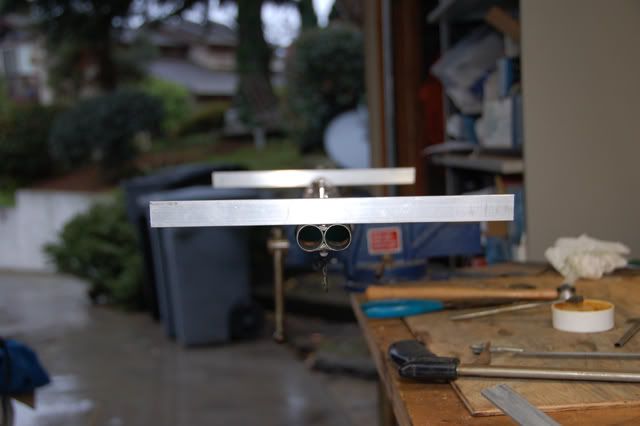 
|
|
|
|
|
Joined: Jan 2006
Posts: 15,465 Likes: 89
Sidelock
|
|
Sidelock
Joined: Jan 2006
Posts: 15,465 Likes: 89 |
Did you pattern it before you relayed the ribs ?
|
|
|
|
|
Joined: Feb 2007
Posts: 116
Sidelock
|
|
Sidelock
Joined: Feb 2007
Posts: 116 |
This is just my view, but I am first interested in point of aim performance....that is, when properly fitted and mounted in a repeatable stance, does the gun hit where I point.
If there is a problem showing when patterning off-hand, then I believe you need to sand bag the gun on a stable platform and pattern it like you were sighting in a rifle....this will provide definite proof if you have a point of impact issue, and in particular a difference in point of impact between the two barrels.
I'm sure there are many more expert at this than I...just wanted to share my thoughts.
Cheers
Cheers
Stephen
|
|
|
|
|
Joined: Jul 2005
Posts: 7,065 Likes: 1
Sidelock
|
|
Sidelock
Joined: Jul 2005
Posts: 7,065 Likes: 1 |
Baron I agree. If the barrels both shoot to the same point the stockers can fix the gun to shoot where I look.
Best,
Mike
I am glad to be here.
|
|
|
|
|
Joined: Jul 2008
Posts: 30
Boxlock
|
|
OP
Boxlock
Joined: Jul 2008
Posts: 30 |
Mike --
I found the Winchester Model 21, barrel finishing, discussion you posted interesting. But, in your posting the Winchester discussion of barrel regulation was solely focused on the height of the point of impact for both barrels with respect to the siting plane. The bending process is clearly a way of controlling the height of the point of impact -- at least on SXS designs. The bending process affects both barrels in roughly the same way in moving the respective patterns up or down. O/U designs may not be amenable to this approach with respect to point of impact height, based on structural considerations related to stacked barrels.
But, in the posted outline on barrel regulation there was no reference to barrel regulation procedures related to superimposing the point of impact of both barrels on the same point at 40 yards. Here, I am referring to the barrel to barrel pattern regulation. Was there any discussion of this point in the Winchester reference?
Thanks.
Best Regards,
Don
Don Henderson
|
|
|
|
|
Joined: Feb 2004
Posts: 13,883 Likes: 21
Sidelock
|
|
Sidelock
Joined: Feb 2004
Posts: 13,883 Likes: 21 |
I have some minimal experience in regulating barrel to barrel POI from my conversion of a 20g to 28g. In my several correspondences and phonecons with Kirk Merrington, and others that have done it, they cautioned me to shoot the gun off-hand only for evaluating the POI. Their opinion was that the resistance of bench shooting the gun was different than off-hand, which could result in different POI. But, since I have never shot for POI from a bench vs. off-hand, I can't provide any direct experience there.
|
|
|
|
|
Joined: Jul 2008
Posts: 30
Boxlock
|
|
OP
Boxlock
Joined: Jul 2008
Posts: 30 |
Chuck --
Your posting outlining your restoration work on the Parker is remarkably interesting.
The fixturing you show in the photos is substantiallty self explanatory in most respects. But, how did you control the spacing betwen the barrels? You indicated and the picture shows the barrels are in contact at the muzzle. I assume that the chopper lump provided another point at which the side to side position of the barrels were fixed. Did you use spacers along the seam betweens the barrels to eliminate bowing and to provide for barrel straightness and parallelism between the barrel bore axes?
Additionally I assume you may have used "soft", Tin-Lead, solder ( and not a brazing alloy) to join the barrels. The required fluxes for soldering to steel are often corrosive. Was there a potential problem with flux entrapment within the solder joints? How did you "handle" this potential problem?
Thanks,
Regards,
Don
Don Henderson
|
|
|
|
|
Joined: Feb 2004
Posts: 13,883 Likes: 21
Sidelock
|
|
Sidelock
Joined: Feb 2004
Posts: 13,883 Likes: 21 |
Don, I did a 'how to' thread a while back on the re-laying of ribs. Yes there are spacers between the barrels that get tinned. All tinning is done with acid flux with the parts separate from one another. Getting solder to stick without acid flux is a problem. Once the tinning is done on all the parts, a thorough cleaning to remove the residual acid flux is necessary. Soap and water with a Scotchbrite pad and small wirebrush is what I used. This link to Drew's site that captured my thread and some of Dewey McVicker's and Oscar Gaddy's ideas is a great reference. http://www.picturetrail.com/sfx/album/view/18691676/297178486BTW, I used 60/40 tin/lead solder. A friend that does high-end conservator/restoration type of work for a living suggested going to 63/37 true eutectic solder for the lowest melting point, but I didn't find I needed it.
Last edited by Chuck H; 07/15/08 08:35 AM.
|
|
|
|
|
Joined: Jul 2005
Posts: 7,065 Likes: 1
Sidelock
|
|
Sidelock
Joined: Jul 2005
Posts: 7,065 Likes: 1 |
Hi Don:
I probably should have edited more out but the paragraph I posted last has this sentence in it: "Both barrels were expected to impact the point of aim at the same place."
Best,
Mike
I am glad to be here.
|
|
|
|
|
Joined: Apr 2002
Posts: 432 Likes: 30
Sidelock
|
|
Sidelock
Joined: Apr 2002
Posts: 432 Likes: 30 |
Some questions-
-I bought a 12 gauge insert that cast a laser, thinking that this would help identify POI of barrels, but I guess this would only show where the center of the chamber was pointed and have little or no influence on pattern centers?
-It seems like POI should be measured at the distance most shooting would be done? 22 yards for skeet perhaps? 35 yards for the 1st barrel at trap and maybe 50 yards for the second barrel? Games guns at...........
PULL!
Hal M. Hare
|
|
|
|
|
Joined: Feb 2004
Posts: 13,883 Likes: 21
Sidelock
|
|
Sidelock
Joined: Feb 2004
Posts: 13,883 Likes: 21 |
The lasers that fit the chamber may tell you where the chambers are pointed, but could be very far off a barrel set with regulation problems. I've even given some thought to making up a laser to fit the bores and put it in near the muzzles as possible, but the choke alignment is the last word on where the pattern hits, or at least has the last influence.
|
|
|
|
|
Joined: Jul 2005
Posts: 7,065 Likes: 1
Sidelock
|
|
Sidelock
Joined: Jul 2005
Posts: 7,065 Likes: 1 |
Chuck don't SxS barrels made in the traditional manner have to bend bend. That is the breech walls are substantially thicker than the muzzle walls and both touch. If the barrels didn't bend then at 40 yards the left barrel would shoot 3 feet to the right and right barrel would shoot 3 feet to the left.
Best,
Mike
I am glad to be here.
|
|
|
|
|
Joined: Jul 2008
Posts: 30
Boxlock
|
|
OP
Boxlock
Joined: Jul 2008
Posts: 30 |
Mike --
I saw the phrase, "Both barrels were expected to impact the point of aim at the same place.", but, did not know what lay behind the assertion.
I assume that the phase means that the Winchester people had a design and barrel joining process which reliabily produced the same point of impact for both barrels.
If true, it is not clear that the important elements of this joining processs are known my all members of the industry, currently.
By the way, it is over a week, now, since sending my note to B. Rizzini, inquiring as to the tolerance for the differential in the barrels' points of impact, which they could guarantee, on a new set of barrels. This inquiry resulted from their suggestion that I could purchase a new set of barrels to resolve my current patterning problem with my B. Rizzini shotgun. After sending the note, I have called the representive twice and left messages. To date, the silence is deafening.
Thanks.
Best Regards,
Don
Don Henderson
|
|
|
|
|
Joined: Feb 2004
Posts: 13,883 Likes: 21
Sidelock
|
|
Sidelock
Joined: Feb 2004
Posts: 13,883 Likes: 21 |
Mike,
On the few 12g sxs guns I've taken the time to look at, the barrels were each straight, but converging. I don't recall the amount off hand now. But the number is substantial. Measuring the outside across both muzzles and then back a foot will give you an idea of the convergence. The barrels do indeed "cross point of aim", but the theory is that the recoil causes the gun to rotate and align the barrel with the point of aim (POA)as the payload exits the barrel.
|
|
|
|
|
Joined: May 2006
Posts: 810 Likes: 15
Sidelock
|
|
Sidelock
Joined: May 2006
Posts: 810 Likes: 15 |
I forgot to mention on page 2 that the Grulla would pattern to point of impact on the right barrel and 6" low on the left barrel. hope this clears up any questions.
-Shoot Straight, IM
|
|
|
|
|
Joined: Jul 2008
Posts: 30
Boxlock
|
|
OP
Boxlock
Joined: Jul 2008
Posts: 30 |
Chuck --
I have now had a chance to view the pictorial overview of the Parker barrel reconditioning:
(http://www.picturetrail.com/sfx/album/view/18691676/297178486
I must say I think you did a great job in putting this instructional overview together.
Very Nice !
Your point about the sequential use of acid and then rosin fluxes is now clear. Your discussion on this point is absolutely correct, important and well done. ( At one time I did research on the new, lead-free, solders for IBM -- before retiring in May. )
Thanks for the reference.
Best Regards,
Don
Don Henderson
|
|
|
|
|
Joined: Feb 2004
Posts: 13,883 Likes: 21
Sidelock
|
|
Sidelock
Joined: Feb 2004
Posts: 13,883 Likes: 21 |
Don,
Thanks for the vote of confidence. I was treading on new ground for me and while I have soldering and jigging background, I had not done nor seen the process except for bits on video clips. But, past learned experiences and those bits took me thru it well. I'm now armed to buy a gun most would shy away from due to the cost of re-laying ribs and re-blueing.
I did buy some homogenized solder with rosin flux mixed in, but didn't find the need for it. In some of Oscar Gaddy's notes or correspondence, he suggested the use of such. I found it fairly expensive and not necessary.
|
|
|
|
|
Joined: Jun 2006
Posts: 3,394 Likes: 492
Sidelock
|
|
Sidelock
Joined: Jun 2006
Posts: 3,394 Likes: 492 |
How come no one has just told Don to take Galazan's offer, and be done with it?
It's a nice discussion, but is also the long way around his original question.
Out there doing it best I can.
|
|
|
|
|
Joined: Jul 2008
Posts: 30
Boxlock
|
|
OP
Boxlock
Joined: Jul 2008
Posts: 30 |
ClapperZapper --
In response to your question, the critical point is that I have had no response from Rizzini with respect to the tolerance on the respective points of impact for the two barrels on a new set. I sent an e-mail over a week ago with a formal inquiry and I made two telephone calls and left messages. To date, no response.
I would hate spend the money on a new set of barrels and find myself in a situation with little or no improvement in the barrel regulation .... and more wasted time. Without some sort of guarantee on the maximum, barrel to barrel, point of impact tolerance that Rizzini will stand behind -- there is clearly a problem and no clear solution.
Right now, the "compensating choke" solution seems to be the leading candidate. I sent a formal inquiry to Briley, yesterday. No formal response, yet. But, in an initial telephone conversation, the Briley representative felt very confident in achieving a good technical solution. This approach may be cost effective. as well.
Best Regards,
Don
Don Henderson
|
|
|
|
|
Joined: Feb 2004
Posts: 13,883 Likes: 21
Sidelock
|
|
Sidelock
Joined: Feb 2004
Posts: 13,883 Likes: 21 |
Don,
I'd sure give Mr Eyster an opportunity to assess it and give an estimate based on his reputation alone.
|
|
|
|
|
Joined: Jul 2008
Posts: 30
Boxlock
|
|
OP
Boxlock
Joined: Jul 2008
Posts: 30 |
Chuck --
I will give Kyster a call, tomotrrow. I was able to run down some additional information on him. The article I found was quite laudatory.
But, it appears to me that -- in the absence of new barrels -- the only recourse will be to use modified chokes which compensate for the present barrels', point of impact, divergence.
I cannot vizualize another, workable, physical solution.
We will see what Kyster has to say and I will let you know what happens.
Thanks.
Best Regards,
Don
Don Henderson
|
|
|
|
|
Joined: Feb 2004
Posts: 13,883 Likes: 21
Sidelock
|
|
Sidelock
Joined: Feb 2004
Posts: 13,883 Likes: 21 |
Don,
Best luck to you on this.
|
|
|
|
|
Joined: Jul 2008
Posts: 30
Boxlock
|
|
OP
Boxlock
Joined: Jul 2008
Posts: 30 |
Chuck --
Well, I contacted Eyster Heritage Gunsmiths, this morning.
Very interesting discussion ..... Very
Ken is no longer actively engaged with the business. So, I spoke with Tim, Ken's son, concerning my B. Rizzini O/U patterning (point of impact) problem. It appears that my particular problem is not an isolated one. Apparently, there are a large number of B. Rizzini, O/U, owners which are "beating a path" to the Eysters' door for help -- all with similar problems. There would seem to be -- or, at least, has been -- a systematic production problem at B. Rizzini. Interesting .... if it was not for my bad luck, I would not have any luck at all.
It turns out that Ken's son, Jim, is the individual in thier gunsmithing group who, now, handles the "barrel work". Jim is presently away at the Olympic trials with his own son, who ostensibly has a "shot" at making the team. I will call Jim next week to discuss what may be done to correct my problem. But, Tim commented that the 16 inch divergence ( at 40 yds.) for the points of impact for the two barrels on my gun was very large and their standard approach, to correct such problems, may not work. I will know more when I speak with Jim on Monday or Tuesday. But, they are presently "swamped" with work. Tim sounded harried.
For the recond, Chuck, here is the contact information for the Eysters. Their phone number has recently changed.
Eyster Heritage Gunsmiths
6441 Bishop Rd.
Centerbug, OH 43011
Ph: (740) 6250-6131
No word from Rizzini / Galazan ... or Briley, yet.
Best Regards,
Don
Don Henderson
|
|
|
|
|
Joined: Feb 2004
Posts: 13,883 Likes: 21
Sidelock
|
|
Sidelock
Joined: Feb 2004
Posts: 13,883 Likes: 21 |
Don,
That information certainly is helpful to those that may have been considering a B. Rizz gun. I had seen some of their guns and thought of them for some of my hunting uses, but that's not on the table now.
Given that this condition may exceed the ability of EHG to eliminate completely, I'd would think there would be some visual cues. If you lay the barrel on its side and sight along the upper barrel, does it noticably 'swoop' up?
|
|
|
|
|
Joined: Jul 2008
Posts: 30
Boxlock
|
|
OP
Boxlock
Joined: Jul 2008
Posts: 30 |
Chuck --
In response to your posting directly above ....
Now, this problem is getting really interesting -- if confusing.
I undertook your suggested evaluation by coating the barrels lightly and uniformly with oil and viewed the sides of the barrels against a uniformly lit, blue, sky. There was no obvious "swoop" at the muzzle for either barrel. But, the barrel profiles could obscure a slight swoop.
Pursuing the point, yet, further, I undertook the following evaluation. I have extended Briley chokes for the gun. The extension for the chokes is about 0.5 inches in length. And, indeed, the extension of both choke are round by caliper measurment, as would be expected based on the machining techqiue used to fabricate them. They show no measurable difference in diameter over their extension length, i.e., they have no taper, +/- 0.0005. The seperation between the chokes at the muzzle appears to have been designed to have an approximately 1 mm gap. Placing a 0.0385 shim between the choke extensions, it just snugly fills the gap between the choke extensions. This shimmed choke configuation can then be viewed "side on" against a back light, to determine whether there is a taper in the shimmed gap - between the shim and the extensions -- from the muzzle to the end of the choke extensions. The answer to this experimental question is that I can discern no taper in the gap. Based on using the calipers as a gauge, I think I should be able to discern a taper in the gap in this shimmed configuartion, if it were 0.001 to 0.002 inches or larger. If a lack of parallelism between the chokes, alone, was the cause of the 16 inch divergence, I should see an increase in the gap of 0.0055 inches from the muzzle to the end of the choke extensions. ( 16/ 1440 X 0.5 inches) Obviously, I did not find this result.
I then undertook an additional evaluation. re: barrel to barrel alignment. Placing the barrels on a cushioned support, I position the barrels, such that I could view the apex of a tall tree against the sky at approcximately 40 yards distance. The barrels were positioned and then fixed, such that the apex was centered in the view through the upper barrel, using the concentricity of the muzzle and chamber image rings for eye alignment. Without touching / moving the barrels, I viewed the apex through the lower barrel along the axis of this barrel in the same manner. The apex was centered in the view. The two images were not discernably different. This result indicates that the bores of the barrels are approximately parallel.
Interesting ..... if confusing. So .... now where ....
Thus, far I have not considered gun dynamics (recoil) before the shot charge leaves the muzzle. There is an intrinsic difference in torque and barrel movement generated by the upper and lower barrels in association with recoil. This would provide for a difference in upward barrel rotation from upper to lower barrel -- the upper barrel producing a larger rotation. But, I have always considered this effect to be very small. On the other hand, I have never tried to qualtitatively estimate this difference. If this effect is a contributing cause, the differential in the upward movement of the muzzle during recoil would have to be a none trivial fraction of an inch. On the face of it -- this seems to be a very large differential movement in the short barrel transit time for the shot charge. I could attempt to make such a calculation, but, it would take some time to characterize the parameters needed for even rough estimates. Do you know whether anyone has made and published such estimates? I suppose I could use some 3 inch - 1 1/4 oz loads in point of impact pattern testing. This would magnify the differential in the point of impact between the barrels -- if recoil is a significantly contributing parameter.
So, to date .... Not much progress in providing for an understanding of the origins of the problem. Interesting, though.
Best Regards,
Don
Don Henderson
|
|
|
|
|
Joined: Feb 2004
Posts: 13,883 Likes: 21
Sidelock
|
|
Sidelock
Joined: Feb 2004
Posts: 13,883 Likes: 21 |
Don,
I think you may have revealed the problem. My recollection, though only from memory of having looked at O/U gun barrel convergence yrs ago, what that the lower barrel should 'point up' more than the upper. The rationale I came up with this was that the upper barrel has more effect on muzzle lift during recoil. I think you can check this out on a Kgun or Rem 32/3200 pretty redily since they don't have side ribs.
I'm thinking your choke bore/threads in the barrels should not be parallel. I'll check some o/u's of mine tonight.
|
|
|
|
|
Joined: Jul 2005
Posts: 7,065 Likes: 1
Sidelock
|
|
Sidelock
Joined: Jul 2005
Posts: 7,065 Likes: 1 |
16 inches of slope in 40 yards is a deviation of about 3/8" in 30" barrels which I would think would be easy to see looking at the barrels. I mean that centerline of the muzzle end of the barrels is 3/8" wider apart than the breech end centerline. Even an old Californian that liked Labradors could see it.
I got into a long and disagreeable discussion of this problem of non-matching POIs over on 16gauge.com. Once on a gun built by ROTA and once on a B. Rizzini. I believe you can peer down the barrels all you want to but the only way to tell where it is going to impact for you is to shoot it off hand at a pattern board.
Earlier in this thread Chuck pointed out the theory on side by sides was that the converging barrels effect on POI would be offset by the assymetrical recoil of the barrels. If the barrels on an 0/U were parallel the recoil on the top barrel would cause it to shoot higher than the lower barrel using the same reasoning. The moment arm to the shoulder anchor is longer on the top barrel than the bottom barrel.
And if Andre the Giant shot the gun I believe he would get different POIs because his hand is much heavier than Don's. This difference along with Andre's heavier shoulder mass would change the dynamics.
I do believe Don's barrels are defective though. What do you get when you cross an elephant with a rhino? Elephino!
Best,
Mike
Last edited by AmarilloMike; 07/16/08 05:07 PM.
I am glad to be here.
|
|
|
|
|
Joined: Jul 2005
Posts: 7,065 Likes: 1
Sidelock
|
|
Sidelock
Joined: Jul 2005
Posts: 7,065 Likes: 1 |
Last edited by AmarilloMike; 07/16/08 04:56 PM.
I am glad to be here.
|
|
|
|
|
Joined: Jul 2008
Posts: 30
Boxlock
|
|
OP
Boxlock
Joined: Jul 2008
Posts: 30 |
Chuck --
Please let me know what you find in evaluating you gun.
I heard briefly from Briley. They found my letter of inquiry a little overwhelming. They are working on the response.
In all -- I really think that a gunsmithing group that develops an effective, low cost, reliable solution to the manifold, double gun, point of impact, patterning problems -- will "make a mint". But, this will require -- that their solution becomes widely known and -- that the public takes the time to understand what they actually own for "shotguns". Perhaps, the Eyster group has arrived, "technically", already. I expect that Briley could, also, quickly join that group. But, the public may be substantially in the dark. This last point is the one that needs correction.
We'll see. Interesting.
I will be away for a few days -- my eldest daughter is getting married on Saturday.
Best Regards,
Don
Don Henderson
|
|
|
|
|
Joined: Jul 2008
Posts: 30
Boxlock
|
|
OP
Boxlock
Joined: Jul 2008
Posts: 30 |
Mike --
I found the first of your web references (in your latest posting) very helpful, indeed. Very educational.
I would like to thank you for this effort. Your first web reference sheds some considerable light on this thread and the B. Rizzini, point of impact, patterning problem -- since the required convergence of the barrel/choke axes - in the gun in question - appears to be absent.
Thanks very much for your help in this matter. Appreciated.
Best Regards,
Don
Don Henderson
|
|
|
|
|
Joined: Jan 2006
Posts: 15,465 Likes: 89
Sidelock
|
|
Sidelock
Joined: Jan 2006
Posts: 15,465 Likes: 89 |
I'd try different choke tubes and shoot the gun off a solid rest.
|
|
|
|
|
Joined: Jul 2008
Posts: 30
Boxlock
|
|
OP
Boxlock
Joined: Jul 2008
Posts: 30 |
All -
I received an e-mail a response from Briley. At least the Briley organization was forthright and did noy "over-promise".
Please see attached note from Ted at Briley.
---------------------------------------------------------------
We have read and discussed your very well written letter.
These barrels should have gone back to the Manufacturer. This is not an "out of warranty' issue.
Briley and it's gunsmiths pass on this project. You are correct. (given the amount of correction I am worried that the necessary choke geometry for compensation may "push" the physical limits of what can be done without overly thin choke wall thickness in some areas of the chokes)
The deal breaker of course is moving the POI ....16 INCHES.
The other is using the word "guaranteed by Briley".
Although we appreciate you contacting us regarding this project, it is my opinion that we would not be able to undertake this project and satisfy your expectations.
Please feel free to contact us in the future with a more doable project.
Ted
Best Regards,
Don
Don Henderson
|
|
|
|
|
Joined: Jul 2005
Posts: 7,065 Likes: 1
Sidelock
|
|
Sidelock
Joined: Jul 2005
Posts: 7,065 Likes: 1 |
Don you are very welcome.
Best,
Mike
I am glad to be here.
|
|
|
|
|
Joined: Feb 2004
Posts: 13,883 Likes: 21
Sidelock
|
|
Sidelock
Joined: Feb 2004
Posts: 13,883 Likes: 21 |
I just checked my Beretta 682 Gold E 32" bbls for convergence. Near as I can tell, there's about .160 convergence over the 32" length. I'm now teaching my Lab to poop on Texan's boots. 
Last edited by Chuck H; 07/16/08 07:26 PM.
|
|
|
|
|
Joined: Jan 2002
Posts: 14,498 Likes: 2264
Sidelock
|
|
Sidelock
Joined: Jan 2002
Posts: 14,498 Likes: 2264 |
Don,
Hope the wedding goes well and the barrel issue, too. If you fail to get it resolved my suggestion would be to get rid of the gun and move on. The barrel regulation problem does indeed exist, in most brands. There are exceptions, however.
One alternative would be to get a Perazzi, if you really like the style and handling of the Rizzini. I couldn't afford a new one, and really wanted to shoot one in registered sporting, so looked around until I got lucky. Fact is, you can fine very nice MX-8's, old but sound, for the money you've got in a new Rizzini. And you will not have regulation issues with them. In the last 10 months I have gotten two, one at $1850 and another much newer and probably a 98% gun for $3400. Both with 31 1/2" barrels and both tight as a drum. The last one still has to be pushed down to open. K guns will not have the regulation problems either. I just like the Perazzis better.
Good luck, Stan
May God bless America and those who defend her.
|
|
|
|
|
Joined: Jul 2008
Posts: 30
Boxlock
|
|
OP
Boxlock
Joined: Jul 2008
Posts: 30 |
Stan --
Thanks for your note. You are probably right. The gun may be so bad that it is not "fixable"..... no clear way to put it right.
The basic problem is, however, that this B. Rizzini gun is a 2o ga., field gun. I purchased the gun primarily for grouse and woodcock hunting. It weighs about 6.6 pounds. Perazzis are very nice and there is a major dealer not too far away. But, except for the 12 ga. Mirage (I think that is the model) I know of no Perazzi field gun. My impression is that the Mirage is heavier than I would like.
What do know about Perazzi field guns? Perhaps my impressions are wrong.
Regards,
Don
Don Henderson
|
|
|
|
|
Joined: Jul 2005
Posts: 7,065 Likes: 1
Sidelock
|
|
Sidelock
Joined: Jul 2005
Posts: 7,065 Likes: 1 |
I'm now teaching my Lab to poop on Texan's boots. And after I told Phil off for you! You have no sense of gratitude. Mike
I am glad to be here.
|
|
|
|
|
Joined: Feb 2004
Posts: 13,883 Likes: 21
Sidelock
|
|
Sidelock
Joined: Feb 2004
Posts: 13,883 Likes: 21 |
Mike,
My wife says I need to stick up for my dog.
Don,
Pguns do indeed come in field configs. The 20g frames along with slender straight stocks are available and the guns can get down around the weight of your B.Rizz. They are beauties. I have a friend with a .410/28g field gun in a high grade. What a knockout. Prices are the only deterent to me on the small gauge Pguns.
|
|
|
|
|
Joined: Jul 2008
Posts: 30
Boxlock
|
|
OP
Boxlock
Joined: Jul 2008
Posts: 30 |
Stan --
I guess my view / understanding of the Perazzi product line was behind the times ... dated to the time when they were represented by Ithaca Gun. ( I live in Ithaca )
Just now, I did take a look at the Perazzi web site and was surprized to see a large number of game guns in all the gauges.
Very nice.
But, after pricing them on the web -- I would have to say that these guns - as new - cost more than I can justify expending. Perhaps, if a great used gun deal came along -- but, otherwise ....
Best Regards,
Don
Don Henderson
|
|
|
|
|
Joined: Jul 2008
Posts: 30
Boxlock
|
|
OP
Boxlock
Joined: Jul 2008
Posts: 30 |
Chuck -- Mike --
The barrel convergence angle is difficult to accurately determine. As Mike suggests in his appended website thread from 16ga.com, the needed measurements could depend on the design/manufacturing methods used to achieve the needed convergence of the barrels at the muzzle. The barrels could be angled to achieve the convergence with the chokes mounted in line with the barrrel bores. Alternatively, the chokes,alone could be angled to provide for the convergence, while the barrel bores are essentially parallel. Of course some combination of both procedures / designs could be used to achieve the desired final result.
But for the purpose of the measurements -- no matter which procedure is used to achieve the desired convergence for the angle at which the shot charges exit the muzzle -- the angle between the choke bores at the muzzle is the necessary parameter to measure. But, without some special measurement equipment / fixturing / tooling -- this is a difficult measurement to make. I know that I cannot do it well with what I have at home, here. It is essentially impossible to do this in a store, when considering the purchase of a new gun.
The suggestion that the results of careful patterning of the gun for the points of impact (POI) for the respective barrels is best --- is probably the most pragmatic suggestion / approach. But, the intrinsic difficulty here is that one probably owns the gun by the time the patterning is undertaken to assess the guns point of impact (POI) performance. Without a specification for minimum patterning performance, the manufacturers can and do say that the "gun is within spec." -- as can clearly be gleaned from the above postings in this thread. Catch-22, all over again.
If the necessity for barrel convergence does, indeed, derive from the recoil motion of the gun before the shot charge leaves the muzzle -- then there are several parameters that - in principle - affect the necessary convergence to supperimpose the patterns from both barrels. These parameters include:
1. gun mass / moment of inertia for rotation about the stock heel.
2. shot charge mass / weight
3. shot charge velocity at the muzzle.
4. barrel to barrel spacing
5. stock dimensions.
In principle even the physical attributes of the shooter could affect the patterning outcome. This suggests that the patterning should be undertaken off-hand and with the gun mounted in the "normal" way.
The B. Rizzini POI patterening problem I encountered may have been the result of a poor B. Rizzini design, re: convergence ( most important); 1 oz. field loads used in the patterning; and the gun is light (part of the design considerations).
To prove the point, concerning the importance of / necessity for barrel convergence, I may try patterning the B. Rizzini gun with 3 inch - 1-1/4 oz loads -- when I have time (after the wedding). These loads should significantly amplify the problem, if this barrel convergence, design, deficiency is the origin of -- or substantially contributing to -- the problem.
Regards,
Don
Don Henderson
|
|
|
|
|
Joined: Mar 2005
Posts: 5,021
Sidelock
|
|
Sidelock
Joined: Mar 2005
Posts: 5,021 |
I can't for the life of me figure out how an Italian built shotgun is that far out of POI. And the answers Don was given from some noted firms makes even less sense. Within acceptable tolerance, that's useless!!!
|
|
|
|
|
Joined: Jul 2005
Posts: 7,065 Likes: 1
Sidelock
|
|
Sidelock
Joined: Jul 2005
Posts: 7,065 Likes: 1 |
I own a mechanical contracting company. I have had lawyers tell me there is NO time limitation on liability for defective materials or defective workmanship. There have been lawsuits over copper hot water water pipes that had been installed for several years and then started leaking. The building owners claimed, among other things, that the installing contractor had not reamed the lip out of the pipe when he cut it and this set up turbulence causing erosion. It broke some very large mechanical contractors.
Best,
Mike
Last edited by AmarilloMike; 07/17/08 12:19 PM.
I am glad to be here.
|
|
|
|
|
Joined: Jul 2005
Posts: 7,065 Likes: 1
Sidelock
|
|
Sidelock
Joined: Jul 2005
Posts: 7,065 Likes: 1 |
I guess the Rizzini could be restocked or the stock bent so that the top barrel shot 8 inches high and the bottom barrel shot 8" low but that still seems out of reason.
Mike
I am glad to be here.
|
|
|
|
|
Joined: Feb 2004
Posts: 13,883 Likes: 21
Sidelock
|
|
Sidelock
Joined: Feb 2004
Posts: 13,883 Likes: 21 |
Contrary to a published recommendations, a friend occasionally unscrews the choke on his gun and shoots a round or two without any choke in the barrel, then reinstalls it like normal. Apparently with no damage. He's been doing this during our sporting clays shoot once a week for yrs.
Don, If you're comfortable with shooting without a choke in the barrel, I'd think that would tell if the choke machining in the barrel was the culprit. Just shoot it for POI at a closer range, say 20 or 30 yds.
|
|
|
|
|
Joined: Jul 2008
Posts: 30
Boxlock
|
|
OP
Boxlock
Joined: Jul 2008
Posts: 30 |
Chuck --
This is my last note / entry for a while -- daughter's wedding and all. Leaving momentarily.
But, in response to your last entry -- you are certainly correct with respect to your suggestion. (You have the makings of a very good experimentalist / researcher.) But I have never fired the gun without the chokes in place. (You should have seen how I cared for this gun.) I have heard that shotguns can be fired with no screw-in chokes in place -- "without damage". While I thought the gun was worth something, I was very hesitant. But, realistically -- with what we, now, know about the gun -- what do I have to loose! And your suggested experiment would shed some, much needed, scientific light on the origins of poor double gun barrel regulation. So .... We will do it!
.... But, "the plot thickens".
Here is what has happened since my last response to you.
I finally got in contact with Rizzini / Galazan. ( My initiative.) Galazan is clearly caught between me and Rizzini. They have offered to sell me new barrels at their (Galazan) cost. .... And, now, the barrels will be patterned and assessed before shipment. This may be the best compromise I can achieve without following up on Mike's suggestion and dragging Rizzini into court. (In deference to Mike, I think we could win in court -- especially if Mike argues the case.)
But, I will call Jim Eyster on Monday and depending on what they think they can do, technically, and the cost structure, I may accept Galazan's offer.... or I may proceed with Eyster. On the other hand - if Eyster is confident and the cost is not too high - I may do both. (Yes, I am just a bit crazy.)
Either way, I think the experiments we have discussed could be undertaken without compromising either potential barrel solution. I will discuss this point with Jim.
So, there are two experiments I will do, which should shed some light on the barrel regulation considerations we have discussed.
1. Your suggested, "chokeless", patterning of the barrels should quickly sort out the contrbutions that the chokes were making to the divergence of the patterns from the two barrels. Actually, I do not think this will harm the barrels, after examining the geometry of the barrels into which the chokes are normally screwed. You may recall that we exchanged chokes between the barrels - in our original experiments - without affecting the patterns' POI's. As previously mentioned, the chokes appear to be very much parallel. Based on these two considerations, I expect that the chokeless patterns may have different POI's -- but, the divergence of the patterns will closely approximate that which we found with the chokes in place. This last statement discounts the importance of the small change in the gun's effective moment of inertia for recoil with the choke removed. We will see.
2. I will pattern the gun with 3 inch, 1-1/4 oz, shells and compare the pattern divergence to that associated with the, previously used 1 oz loads. (Chokes in.) Since these loads have ostensibly very closely approximated muzzle velocities, the differential in recoil kinetics can be easily understood. If the lack of barrel convergence is the primary / controlling source of the POI impact divergence for the two barrels, then I should see an increase in POI divergence of more than 25 %. This experiment will shed light on whether the "toe in" barrel geometry is indeed an important consideration ... and if so by how much.
But, it will take some time to undertake these experiments. I want to make sure I have a back-up barrel plan in case the chokeless experiments go "wrong". And, then, there are my daughters wedding plans and all..... my present house reconstruction, ... consulting work ... trout fishing ... etc.
I promise to send you and the rest of the group a posted report on the outcome of the experiments. This is getting all very interesting. I actually think we are learning about this barrel regulation "stuff".
Best Regards,
Don
Don Henderson
|
|
|
|
|
Joined: Jul 2008
Posts: 30
Boxlock
|
|
OP
Boxlock
Joined: Jul 2008
Posts: 30 |
All --
Well, after speaking with both Eyster Heritage Gunsmiths
6441 Bishop Rd.
Centerburg, OH 43011
Ph: (740) 625-6131 ( Corrected address and phone number)
and with Briley Manufacturing -- I now have some understanding as to the degree of correction that can be achieved by these gunsmithing groups in improving the barrel regulation of a double gun -- at least in the limit of screw-in chokes. I was very much impressed with the seeming competency of both groups. Their replies to my questions were very much self-similar.
Both companies modify the the chokes for the respective barrels to achieve the movement of the point of impact for the patterns in the regulation process.
Both companies quoted similar metrics with respect to what can be achieved. The point of impact for a barrel can be moved, perhaps, 6 -- to an absolute maximum of 8 inches -- at the standard 40 yard distance. Tighter chokes can be "moved" greater distances and more reliably at the 6 to 8 inch extremes. Open chokes present more of a problem and this extreme movement may not be achievable. Pattern distortion increases with increasing point of impact movement. This distortion is small and probably unimportant, if the movement is only 2 to 3 inches. Obviously, the screw-in chokes must be used only in the barrel for which they were regulated.
If greater point of impact movement is need, the barrels may be separated and rejoined, properly. In the limit of barrels joined by brazing -- new barrels is the pragmatic solution. If the barrels are joined with "soft", tin-lead, solder, rejoining may be pragmatic. But, the joining with "soft" solders is more subject to fatigue cracking with extensive use.
Jim Eyster did make the point -- that in his experience -- the determination of the point of impact is somewhat sensitive to "who is shooting the gun" and the load being used. For geometric and recoil movement reasons he suggested that SXS barrel regulation was more difficult than O/U regulation for the manufacturers.
It appears that many, if not most, companies, manufacturing double guns, do have problems with barrel regulation -- at least occasionally .... and some more that others. I found some of the barrel regulation "war stories" [b]absolutely appalling in these discussions. I am still incredulous. But, the better manufacturers, that value their reputations, appear to quickly rectify apparent problems.
Browning appears to be the only manufacturer, which at present, is publishing and guaranteeing specifications for barrel regulation. Browning's specification is for a maximum divergence of 3 inches for either barrel from the point of aim. In the worst case -- if the tolerances for the two barrels added -- the divergence in the point of impact between barrels could be as much as 6 inches. As I understand it, typical Browning results are significantly less / better, however. In my view Browning deserves some credit on this basis.
I find this all very interesting. It is absolutely clear that the barrel regulation of double guns cannot be taken for granted -- no matter who the manufacturers is. Please read the last sentence, again.
Buyer beware!
Best Regards,
Don
Don Henderson
|
|
|
|
|
Joined: Jul 2005
Posts: 7,065 Likes: 1
Sidelock
|
|
Sidelock
Joined: Jul 2005
Posts: 7,065 Likes: 1 |
Don that information cleared up some questions I have had for awhile. Thanks so much for posting it.
Best,
Mike
I am glad to be here.
|
|
|
|
|
Joined: Jan 2002
Posts: 6,959 Likes: 196
Sidelock
|
|
Sidelock
Joined: Jan 2002
Posts: 6,959 Likes: 196 |
I'd send it back to Galazan's and have them take care of it. They'll stand behind it. Tell them to make sure it shoots right before they return it. Good luck.
|
|
|
|
|
Joined: Jul 2008
Posts: 30
Boxlock
|
|
OP
Boxlock
Joined: Jul 2008
Posts: 30 |
Jimmy --
Based on the technical options available to me with respect to the barrel regulation problems ( or, really, the lack of alternative options ), I sent the 20 Ga. O/U back to Rizzini / Galazan, last Friday. Galazan represents Rizzini in the US and has graciously offered to replace the barrels at their cost, plus a fitting fee. However .... after consider communication with Rizzini in Italy, it appears that Rizzini will only guarantee a point of impact vs. point of aim differential of 4 inches or less at 30 meters for new barrels. That metric corresponds to a 4.8- 4.9 inch differential at 40 yards. The Rizzini metric is thus 60 % higher than that guaranteed by Browning. I find the Rizzini guaranteed barrel regulation metric disappointingly large.
Notwithstanding all of the above, Galazan will attempt to do better.
We will see.
Best Regards,
Don
Don Henderson
|
|
|
|
|
Joined: Mar 2005
Posts: 5,021
Sidelock
|
|
Sidelock
Joined: Mar 2005
Posts: 5,021 |
Just slightly off topic but while we wait for Don's barrels to return, I was thinking about barrel regulation and who builds their barrels to the closest tolerances of point of aim compared to point of inpact; my guess would be the English.
This discussion could get real interesting!!
|
|
|
|
|
Joined: Jul 2005
Posts: 7,065 Likes: 1
Sidelock
|
|
Sidelock
Joined: Jul 2005
Posts: 7,065 Likes: 1 |
treblig my current hypothesis is that the two barrel gun shooting to the same point is most important.
I believe that the point of impact of each barrel should be determined by shooting off hand several times out of each barrel at a different target each time.
If the barrels shoot to the same point the stock can be bent to make the POA (point of aim) and the POI (point of impact) coincide.
If the POI of the two barrels are 18" apart as in Don's case if the stock is bent to perfection the best that could be achieved is that one barrel would shoot 9" high and one barrel would shoot 9" low relative to the POA.
And I think with the same gun and charge but different shooters the POI/POA will change from shooter to shooter.
Best,
Mike
Last edited by AmarilloMike; 07/28/08 03:11 PM.
I am glad to be here.
|
|
|
|
|
Joined: Jul 2008
Posts: 30
Boxlock
|
|
OP
Boxlock
Joined: Jul 2008
Posts: 30 |
All –
I started the thread on this subject in June of 2008 -- and now, this will probably be my last entry on the subject ….. Let it be a warning to all. The problem of barrel regulation in my B. Rizzini, 20 Ga, O/U is coming to an ugly end …. without resolution.
You may recall that I encountered a barrel regulation problem with the B. Rizzini, 20 Ga., O/U, in that, the point of impact for the two barrels diverged by about 16 inches at 40 yards. This is unacceptably poor regulation for a double gun. The maximum divergence for the point of impact for the barrels on a double gun should be no more than 3 to 4 inches at 40 yards.
Regrettably, I detected the problem after the 1 year warranty expired. Thus, my only tenable option was to agree to purchase a new barrel set – but, I insisted that the new barrels meet the 3 to 4 inch divergence criteria. Connecticut Shotgun Manufacturing Co (CSMC / Galazan) represents B. Rizzini in the US, so my communications were with and through CSMC. But, the represented B. Rizzini’s position was that they would only guarantee a divergence of approximately 6 inches at 40 yards. This is a very poor excuse for an acceptable standard.
I sent my gun to CSMC in July of 2008, with the understanding that the barrels would be replaced and fitted – with the gun returned to me in September. That was the CSMC / B. Rizzini stated plan in any event. It never happened.
Well, the saga dragged on interminably. The order was “handed off”, sequentially, to three CSMC representatives. The first was fired or quit. The second misplaced …. and found my gun twice with prompting via resending of the e-mail history. He could not seem to remember the order for the new barrels -- when I contacted him several times by phone or e-mail. I had to bring him up to speed on each subsequent contact. He could not remember what the order was all about.
The third CSMC representative, who took over in September, indicated that that the barrels would be delivered in November. When the November date passed, I contacted him and he indicated that the barrels had not been delivered by B. Rizzini at the expected date. I then had to ask him - press him for a revised plan for the date of delivery. He had no definitive response -- other than to say it should not be more than 60 days. Well, you can all guess that after 60+ days I contacted CSMC. This third CSMC representative indicated that he had no date, yet, for the delivery of the new barrel set from B. Rizzini …. and unbelievably …. he had lost the “thread” and forgotten that the gun was still in the possession of CSMC. So, he suggested that I would have to send the gun to CSMC for barrel fitting. He had never carefully read my multiple notes to him with the complete transaction / communication history over several months. I had to ask that he try to relocate the gun, yet again. It now appears that he has found the gun.
At this point I have asked for the return of the gun ….. with the belief that the situation was truly beyond any reasonable expectation of resolution.
Clearly, CSMC / Galazan demonstrated very “scattered” business practices, having apparently extremely poor business controls and processes. To my great surprise they seemed completely incompetent. I had certainly not anticipated this result, given the image that CSMC wants to portray and their reputed position in the industry . I had not anticipated the B. Rizzini shotgun patterning problem, based on their advertised emphasis on "machining precision".It seems that in this instance that both the gun manufacturer (B. Rizzini) and their US sales representation (CSMC) are sorely lacking in technical and business competency. Absolutely, unbelievable!
When I started my odyssey to own a “good” grouse and woodcock gun a few years ago, I did not expect the project would be all that difficult. But, this odyssey began because my previous shotgun, also, had a barrel regulation problem. At the time I thought that this problem was unusual – perhaps singular. So, I naively purchased the B. Rizzini shotgun. I was in error on multiple counts. Finding a gun that shoots where it points appears to be a non-trivial task. I hope this documentation of my trials and tribulations is helpful to you all and acts as a warning. Buyers beware!
Best Regards,
Don Henderson
Last edited by Don Henderson; 02/01/09 02:07 PM.
Don Henderson
|
|
|
|
|
Joined: Apr 2002
Posts: 251
Sidelock
|
|
Sidelock
Joined: Apr 2002
Posts: 251 |
Don
I am very sorry to learn about your ongoing difficulty. I have certainly abandoned all ideas of ever buying a Rizzini. As you have suggested, the problem with poor regulation is probably much more wide-spread than realized. The American Rifleman used to publish test patterns as part of their doublegun reviews. They often looked terrible to me.
I have not done any patterning for years, but did do some a long time ago. Results then with Belgian Brownings and a Perazzi showed excellent regulation, both before and after Briley installation. After your problems, I will probably do some this year with my current shotguns. Actually, patterning should be the first thing we all do after acquiring one.
As you note, manufacturers count on us not doing any. This is at least part of the reason that shotguns that look like Perazzis sell for much less. My current 20 ga is a Browning Model 12 pump and will be unless I can afford a Perazzi in the future. Given the economy, that does not appear likely.
Last edited by vangulil; 01/31/09 11:12 AM.
|
|
|
|
|
Joined: Jul 2008
Posts: 30
Boxlock
|
|
OP
Boxlock
Joined: Jul 2008
Posts: 30 |
I think the comments by Vangulil, above, are probably correct.
Guns are tools; but, in their evolution, the gun designs and their fabrication have been refined to the point of becoming art forms. In fact the art form is now emphasized in many ways over the functionality of the gun as a tool by us, as purchasers.
It appears that guns are rarely critically evaluated by their owners for their function as a tool, such as patterning or the point of impact divergence under discussion in this thread / topic. It takes work and time to do so. This reality appears to not have gone unnoticed by the manufacturers. The manufacturers deliver quality in those features which can be easily / directly evaluated -- essentiallly what can be seen and evaluated in the purchase process. These are basically art form attributes. From the facts, accumulated over time by many contributors in this thread, it appears that the emphasis on the functionality of the gun, as a tool, has regrettably become a "second order" consideration for many manufacturers. We, as buyers of these products, need to turn this around. More emphasis in the gun reviews should be given to functional capabilities and in particular to patterning which characterizes the primary function of the shotgun. As noted in the comments above, many of the, so called, critical shotgun reviews do not report on patterning evaluations. Rather, they report the atributes of the gun which reflect the art form. Many of these, art form, attributes are certainly important. But, if the gun does not shoot where it points -- the art form attributes are reduced to being meaningless in the overall context.
Regards,
Don Henderson
Last edited by Don Henderson; 01/31/09 04:48 PM.
Don Henderson
|
|
|
|
|
Joined: Apr 2002
Posts: 251
Sidelock
|
|
Sidelock
Joined: Apr 2002
Posts: 251 |
As for the question as to which manufacturers best regulate their barrels, I think the answer would be those who build guns for the most demanding levels of comptetion AND build essentially the same gun for field use. I expect that an Olympic class clays or high stakes flyer shooter with reputation and money riding on performance is not going to accept anything less than outstanding regulation.
Perazzi, Kreighoff, and Fabri come to mind. They are used by top-level competition shooters and their field and target guns differ only in minor details. I am sure there are others.
|
|
|
|
|
Joined: Jul 2008
Posts: 30
Boxlock
|
|
OP
Boxlock
Joined: Jul 2008
Posts: 30 |
Vangulil –
You raise some interesting points. Specifically, which manufacturers make the best regulated shotguns? And, if there is a problem with barrel regulation, which manufacturers fully rectify the problem immediately? Based on my experience, obviously B. Rizzini does not perform well with respect to either question.
But, in this odyssey of mine I have spoken with a great number of personal acquaintances, gunsmithing concerns and shotgun manufacturers on the subject of shotgun barrel regulation. These discussions have included gunsmithing enterprises which have worked on perfecting barrel regulation by choke modification for Olympic trials, as outlined in my previous postings on this topic. These concerns have seen guns from many different manufacturers. What I have learned is interesting and gives me some pause. So, for the benefit of those utilize this forum, let me provide some of the information obtained in this way.
First, none of the shotgun manufacturers seem to be immune to having barrel regulation problems in their products. This statement includes at least two of those companies you mentioned in your posting, directly above. Interesting what? However, based on several reports -- in very instance these two companies immediately rectified the problem. But, the assumption of responsibly and rectification of the problems by the manufacturers is not always the case – even with high priced guns. As reported in one of the postings, above, by AmarilloMike on this topic, his Beretta SO5 had a 7.2 inch point of impact divergence between barrels at 40 yards. Other postings report even worse results for some Grulla and Fabarm guns. In some of these cases it was reported or implied in the postings that the manufacturers claimed that the guns were “within specification”. If true, these are absolutely ridiculous assertions and are obviously contrived to avoid responsibility.
Only Browning is reported to have a published barrel regulation specification which they will guarantee. This point was mentioned in some of the above postings. I have not been able to find the point of impact guarantee information on the Browning website. But, based on personal conversations and the postings above, it seems that there may be two metrics associated with this specification:
1. The divergence between point of aim and point of impact for each barrel at 40 yards ( Reported as a maximum of 3 inches)The point of aim is probably defined with respect to the plane of the rib.
2.The divergence between the point of impact between barrels at 40 yards ( Reported as a maximum of 4 inches )
If you think about it, both metrics are required to properly define the point of impact performance for a double gun.
In speaking with several gunsmithing groups it appears that some modestly priced production guns perform better than others, re: barrel regulation. Notably, Browning and Beretta are reported to be better than average in this performance area – but, they are not immune to problems occurring. Much to my chagrin, B. Rizinni was reported to have significant problems.
Regards,
Don
Don Henderson
|
|
|
|
|
Joined: Jul 2008
Posts: 30
Boxlock
|
|
OP
Boxlock
Joined: Jul 2008
Posts: 30 |
All --
It occurs to me that the industry and [b]in particular, the buying public would be well served by the development of a set of industry standards by which the barrel regulation of double guns can be measured / defined. For this purpose method of measurement for the point of aim vs point of impact divergence should be defined or both barrels. In addition the method of measurement for the point of impact divergence between the two barrels should be similarly defined in such a standard. I can think of several simple methods for making these measurements.
The individual manufacturers could then publish their own specification for barrel regulation with respect to these standards, which they are willing to "stand behind" and guarantee. These specifications could provide a competitive advantage to technical competent companies. Even the unilateral adoption of such standards and specification could provide an individual company a competitive marketing advantage.
The current barrel regulation problems, found throughout the industry, appear to derive from the benign neglect of an uninformed public which assumes good barrel regulation as a given .... and from the not-so-benign neglect of most shotgun manufacturers. If the current situation is to change for the better, the buying public may well have to demand this new set of industry standards.
Unlikely? … well, I do not know. But, if a few companies adopt such standards and reasonable specifications, based on these standards .... and this fact is well advertized by those companies that adopt them -- the entire industry may be forced to move in this direction. The technically competent companies and the buying public will benefit from this process.
Regards,
Don
Don Henderson
|
|
|
|
|
Joined: Apr 2002
Posts: 251
Sidelock
|
|
Sidelock
Joined: Apr 2002
Posts: 251 |
Probably the only way the situation would improve would be if enough shooters patterned their guns soon after purchase and publicized the results on sites like this one. Bad publicity might hurt sales enough to get manufacturers' attention. Rizzini has certainly lost sales to readers of this site.
|
|
|
|
|
Joined: Jul 2008
Posts: 30
Boxlock
|
|
OP
Boxlock
Joined: Jul 2008
Posts: 30 |
Vangulil --
Agreed ......... Someone should take your suggestion and start a new topic in this forum which could be used to post the patterning, point-of-impact measurements made by the participants in the forum. Certain protocols would have too be established for the required measurements. But, it seems such an undertaking could cast some important sunlight on the subject and in so doing help everyone.
Any "takers" out there?
Best Regards,
Don
Last edited by Don Henderson; 02/01/09 07:09 PM.
Don Henderson
|
|
|
|
|