|
S |
M |
T |
W |
T |
F |
S |
|
|
|
|
|
|
|
1
|
|
2
|
3
|
4
|
5
|
6
|
7
|
8
|
|
9
|
10
|
11
|
12
|
13
|
14
|
15
|
|
16
|
17
|
18
|
19
|
20
|
21
|
22
|
|
23
|
24
|
25
|
26
|
27
|
28
|
29
|
|
30
|
31
|
|
|
|
|
|
|
|
Forums10
Topics40,328
Posts574,016
Members14,693
| |
Most Online32,084
Jun 14th, 2026
|
|
|
|
Joined: Oct 2008
Posts: 53 Likes: 6
Sidelock
|
OP

Sidelock
Joined: Oct 2008
Posts: 53 Likes: 6 |
I would like to ask [this means you J.D.] about a single set trigger issue. I have a late C.C. Johnson .225 with a SST,it is in beautiful shape, unmessed with, the hammer will only cock after set. I believe it's a factory trigger, it has the 1/2 cock notch. It's not a big deal and I kind of half want to know if old C.C. set them up this way or it's a sticky fly, etc. Lastly is there any reason single set triggers are any more prone to this?
P.S. you're missed over at the kingdom of darkness.
Last edited by tim simbari; 10/22/08 10:09 PM.
|
|
|
|
|
Joined: Sep 2008
Posts: 907
Sidelock
|
|
Sidelock
Joined: Sep 2008
Posts: 907 |
The Kiondom of Darkness.Lots of people are missed.And until they get smart the kindom will keep getting darker. Whitey
|
|
|
|
|
Joined: Aug 2005
Posts: 1,698
Sidelock
|
|
Sidelock
Joined: Aug 2005
Posts: 1,698 |
I for one have not missed it and am glad I resigned.
Ken Hurst
910-221-5288
|
|
|
|
|
Joined: May 2006
Posts: 625 Likes: 1
Sidelock
|
|
Sidelock
Joined: May 2006
Posts: 625 Likes: 1 |
Tim,
You should ask this question over on the ASSRA Board Forum. A relative of C.C.Johnson is a member and he has all C.C.J's work record cards. You will have to provide Johnsons markings (job number)which should be engraved or stamped on the rifle barrel or action. Nothing ventured, nothing gained.
Harry
Biology is the only science where multiplication can be achieved by division.
|
|
|
|
|
Joined: Sep 2008
Posts: 65
Sidelock
|
|
Sidelock
Joined: Sep 2008
Posts: 65 |
I for one have not missed it and am glad I resigned. I agree with Ken and I'm sure a bunch of others. It's a shame that there are a bunch of good guys on the ASSRA site being controlled by a bunch of guys that are so power hungry for control that it hurts the association. I learned one thing real fast, don't ever ask an official a question about the ASSRA and expect a straight answer, it always seems that no matter what the question they seem to have a need to "hide" the answer. Maybe some day things will change, or at least I hope so, and if it does I and I know others will get back to shooting the events. Until things change they will not see any more of my money or support. Set-Trigger
|
|
|
|
|
Joined: Oct 2008
Posts: 53 Likes: 6
Sidelock
|
|
OP
Sidelock
Joined: Oct 2008
Posts: 53 Likes: 6 |
Tim,
You should ask this question over on the ASSRA Board Forum. A relative of C.C.Johnson is a member and he has all C.C.J's work record cards. You will have to provide Johnsons markings (job number)which should be engraved or stamped on the rifle barrel or action. Nothing ventured, nothing gained.
Harry Thanks Harry, that's where it started, that's why I posted it here, a former member will hopefully see this. C.C.'s grandson's records contain some stuff, doubtfull about he adjusted triggers.
|
|
|
|
|
Joined: Sep 2008
Posts: 1,153
Sidelock
|
|
Sidelock
Joined: Sep 2008
Posts: 1,153 |
Tim, I'm going to respond to your question in a more complete manner as soon as I can take some photos and get them posted here. Meanwhile I'll say that yes, the SSTs seem to have more problems than the others, and IMO it's due primarily to their wider availability to some of the less-informed shooters over the years. The SSTs are far more common than the other set-trigger styles and, since they closely resemble the standard setup, it appears to me that many folks thought the little screw adjustment was for the actual trigger pull and not for the set mechanism. Consequently it appears that many of these SST rifles simply had their set mechanisms misadjusted or ignored, while the presumably more informed CCDST and Schuetzen DST shooters were able to keep theirs working properly for the most part.
Another factor that may be a contributor is the relative ease of converting a standard trigger to the SST system. Many of these conversions have been done over the years by parts swappers and home craftsmen, some of them without a full understanding of the specific adjustments required for proper operation.
The design of the wall's hammer is such that the two sear surfaces of the full-cock and safety notches lie at different distances from the main sear's fulcrum; this requires the kicker's position and travel to be adjusted so that the main sear is (just barely) free to engage both notches, and this sometimes is difficult. What usually happens is that the kicker holds the sear either too far forward (doesn't fire when tripped) or too far backward (won't fall into the notch unless the trigger is set). The kicker design allows the sear to have a limited travel arc, and the limits of this arc must be adjusted so that it allows full sear engagement in both sear notches without any special manipulation of either hammer or trigger.
This sometimes proves difficult, but I'll walk you through it in my next post with the aid of photos. At least I'll try...
This would have been a series of articles if The Powers on the dark side hadn't begun losing my article submissions. The SST and the CCDST are especially worthy of further exposition and the home-craftsman conversion to SST would also be a worthy subject.
It may take me a day or 2 depending upon honey-dos and other responsibilities but I'll take some photos and post a further description. Also, I usually have a limited parts supply on hand if needed, and Ballard LLC has them for ransom. However it seems from your description that your problem will be easy to fix without any expense. We'll see.
Regards, Joe
You can lead a man to logic but you can't make him think. NRA Life since 1976. God bless America!
|
|
|
|
|
Joined: May 2006
Posts: 629 Likes: 1
Sidelock
|
|
Sidelock
Joined: May 2006
Posts: 629 Likes: 1 |
To the best of my knowledge, the only man in the free world what actually understands the Winchester single set trigger is Mr. Steele. Personally, I think it is magic. And not necessarily white magic either...
I am most looking forward to the information.
Glenn
There is no sacrifice too great for someone else to make.
|
|
|
|
|
Joined: Sep 2008
Posts: 1,153
Sidelock
|
|
Sidelock
Joined: Sep 2008
Posts: 1,153 |
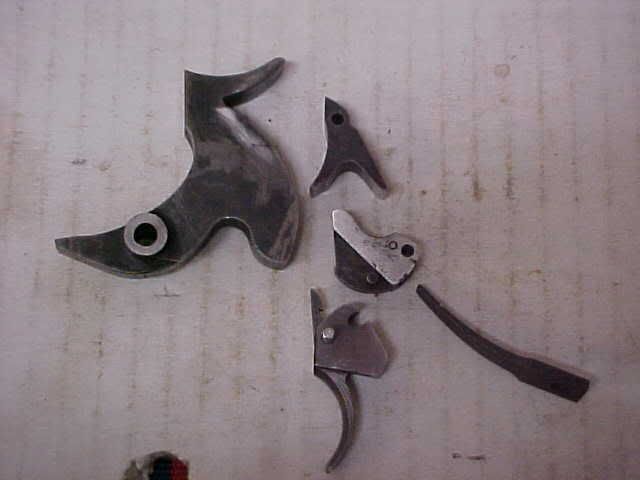 Here's a photo of the main SST parts and their approximate relationships to each other. Yes I know the trigger is missing its adjustment screw and the hammer is missing its safety notch but these were the only orphan parts I could find in a hurry for the photo. Please notice the small secondary set sear ledge on the front of the kicker; this is captured by the hook on the top of the secondary set sear as the trigger is pushed forward in the act of setting it. This setting action moves the kicker downward and away from the primary sear, allowing more sear travel into the hammer's safety notch but also moving the kicker (now set) farther away from the primary sear and so making it more difficult for the kicker to trip it when finally released. The key to the entire arrangement is the SST kicker spring, shown at the right side of the photo. It's much stronger than the standard kicker spring and its forward end bears on the two kicker pins shown at the upper right end of the kicker. These two pins each have their own bearing point across the active end of the spring, and the relative positions and dimensions of these bearing points will determine the angle of the kicker and how it bears against the sear when at rest. By adjusting these bearing points relative to one another, the 'at rest' position of the kicker can be set so that it is A)far enough from the sear to allow the sear freedom to fall into the safety notch at all times and B) close enough to the sear so that the inertia of the kicker & spring will fire the rifle reliably and without too much lag time. This is a very narrow window of adjustment, and is normally achieved by careful stoning or grinding of the two bearing points of the kicker spring. The relative positions of the different parts are dependent upon their dimensions, and variations are common among parts from different sources. And please believe me that many of these old rifles have received parts from MANY different sources over the years. Hand-fitting is the rule and a good understanding of the parts' actions and relationships is important for achieving good results. I realize this is only one quick photo and a hurried exposition of the basics, so please ask more specific questions if/when necessary. I enjoy a little 'pay-forward' of acquired experience and it helps me to organize thoughts for a future article. Regards, Joe
You can lead a man to logic but you can't make him think. NRA Life since 1976. God bless America!
|
|
|
|
|
Joined: Oct 2006
Posts: 803 Likes: 58
Sidelock
|
|
Sidelock
Joined: Oct 2006
Posts: 803 Likes: 58 |
Thanks for this great info Joe! I'm having the exact same issue with my Hi Wall and the SST, so now I can tackle it with confidence!-Vall
|
|
|
|
|

